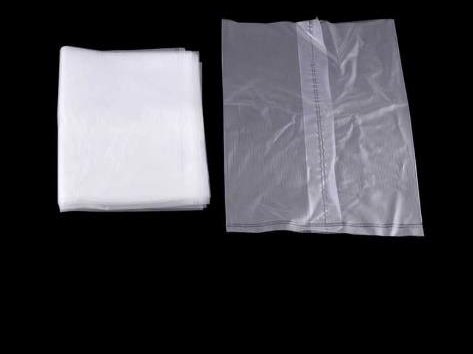
A PVA bag does one job: hold bait together for the cast, then disappear in the water without leaving anything behind. Getting that right is a film specification problem, not a shopping decision.
Why anglers use water-soluble bags
Bait presentation is the whole game in specimen fishing. Loose pellets and groundbait cannot be cast any distance, and a hookbait fished on its own does not lay down the carpet of free offerings that pulls fish into the swim. A water-soluble bag solves both problems at once: bait is packed into the bag, cast as a single package, and the film dissolves on the bottom — leaving the hookbait sitting on top of the free offerings exactly where you want it.
The reason the bag must be water-soluble rather than simply biodegradable is that nothing should be left behind. A bag that survives the session has to be retrieved, and it has usually drifted or been buried by then. PVA leaves nothing to retrieve and nothing on the lake bed, which is why it is the standard material for this job and why it is accepted on so many fisheries.
What makes a fishing bag different
A fishing bag is not a generic water-soluble bag. Three things set it apart.
- It dissolves cold, with no heat to help. Fishing water is ambient — around 5 °C in winter, into the twenties in summer — which puts fishing bags in the cold-water grade family, 20–30 °C. In genuinely cold winter water dissolution slows down: that is physics rather than a film defect, and it is one reason we tune formulation and thickness to the conditions you actually sell into.
- It has to survive the cast. A bag of pellets weighing a couple of hundred grams is subject to real acceleration and impact. Film that is too thin fails in the air or on the leader; film that is too thick sits on the bottom undissolved.
- Water chemistry changes the answer. PVA dissolves more slowly in hard water, and slower again in salt water. A grade that releases in 40 seconds in a soft-water lake can still be mostly intact minutes later in a brackish or marine environment.
That last point is the one most often missed. If you are fishing in strong tidal salt water, tell us at the enquiry stage. The answer is usually a thinner film or a faster cold-water formulation — but it has to be tested, not assumed.
Most fishing enquiries come down to a small number of shapes:
| Format | Typical use | What to specify |
|---|
| Flat bag, sealed on three sides | Pellets or groundbait packed around the hookbait; the standard presentation bag | Width and height of the finished bag, film thickness, pack weight |
| Long narrow bag | Stringer-style bait, or filling a tube feeder | Finished width, length, and how the bag is closed |
| Bag with a folded or lip-topped opening | Bags filled by hand on the bank rather than in a factory | Opening width and how easy it must be to fill with cold, wet hands |
| Pre-filled, sealed bag for retail | Branded bags sold to anglers, filled with your own bait | Fill weight, print, retail carton, barcode area |
Two things drive the price more than the size of the bag does: the film thickness and whether the bag is printed. A small plain bag in a thin film is a very different proposition from a printed retail bag with a moisture-resistant carton. Tell us which end of that range you are at and the quote will be meaningful.
If you need PVA mesh or PVA tape rather than solid film bags, say so at the start — those are a different product line, and we will tell you straight away whether we are the right supplier for them rather than wasting your time.
What to send us
The enquiry that gets a useful answer first time
- Finished bag size — width × height in millimetres, and whether that is the flat or the filled measurement.
- Fill — what goes in, roughly how much, and whether it is dry (pellets, groundbait) or moist.
- Environment — freshwater or salt water, typical water temperature, flowing or still.
- Time window — how long you want the bag to take to release. "Under a minute" and "as it settles" are both usable answers; "fast" is not.
- Quantities — target order size, and whether it is a one-off or a repeating line.
- Packaging — loose in a carton, or retail packed, printed or plain.
With those six points we can recommend a film, produce samples and give you a quote. Without them, any price we give you is a guess, and we would rather not.
The mistakes that ruin a batch
Nearly every problem we are asked about traces back to one of these:
- Film specified too thick. The instinct is that thicker equals stronger. In cold water, thicker means slower — and a bag that is still intact an hour later has failed.
- Ignoring salt water. The same bag that works in a lake releases later in the sea. If your customers fish both, they are not wrong to complain — the specification was wrong for one of them.
- Storing loose film in a damp place. Cold-water film is hygroscopic. Film stored in a shed, a garage or an unheated warehouse in a wet climate goes tacky and then blocks on the roll. Keep it sealed, dry and rotated.
- Filling with wet bait. A damp fill attacks the film from the inside and softens the seals. If the pack goes in wet, the film has to be chosen with that in mind.
- Handling with damp hands. On a bank, in the rain, with wet hands, cold-water film marks and weakens. If your bags are filled by anglers rather than in a factory, tell us — it changes what we would recommend.
How the sampling works
We sample every fishing project before bulk production, because the variables that decide whether a bag works — water temperature, water chemistry, fill weight, cast distance — live at your end, not ours.
Send the specification above and we produce samples in a film we believe fits. You take them out and fish with them. Test them in the conditions you actually sell into, not in a glass of tap water. If they release too early, too late, or fail on the cast, that is useful information and we adjust from there: thickness first, then formulation.
Only after you are happy with the samples do we agree film, size, packing and price for a bulk order. That order, in production, quality check and shipping, is the same process that runs behind every PVA product we make — you can see the same approach applied to detergent film if you want to know what the rest of the range looks like.
If you sell bags rather than fish with them
A good part of our fishing work is for companies that pack and brand their own bait. In that case the film is only half the project: you also need the fill weight to be consistent, the retail carton to keep moisture out, and the print to reflect your brand on a peg or in a tackle shop.
We can supply plain bags for you to fill locally, or pre-filled and sealed bags for retail, and we will talk through the carton and print at the same time as the film, because they affect each other. A perfect bag in a carton that lets moisture through has still failed by the time it reaches the customer.
 Sainsun PVA