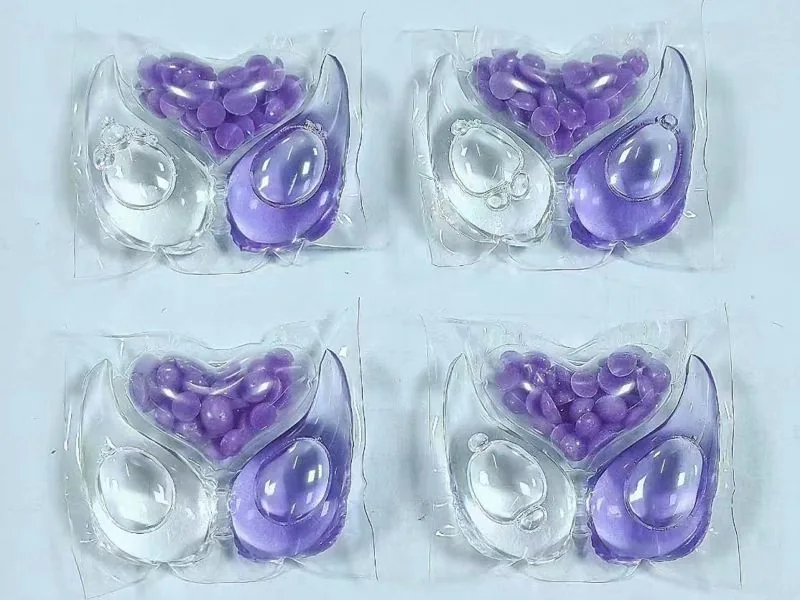
Pod film is judged twice — once in the warehouse and once in the wash. It has to stay intact through humidity, handling and stacking, then dissolve completely without leaving a residue on the fabric. Getting both at once is the whole engineering problem.
What pod film has to do
Detergent pod film is a water-soluble PVA film engineered for two opposite demands. Before use it must be a durable packaging material: it survives humid warehouses, temperature swings, stacking and the rough handling of a filled and sealed pouch. In the wash it must do the opposite — dissolve completely in warm water and release everything, leaving no film residue on the garments and no clogging in the drum or the drain.
That is why pod film is a specification, not a commodity. Thickness, plasticiser level, seal window and dissolving temperature all trade off against each other.
Water-soluble pods packaging: what buyers are actually asking
Most enquiries that start with "water-soluble pods packaging" are really one of three questions. Here is the converter answer to each, without the market-report language:
- Can I launch a pod product without owning a filling line? Yes — we supply film to your filler, or run the filling ourselves as an OEM filling service and ship finished pods.
- What film grade do pods use? The film has to survive the pod’s storage humidity and dissolve in the wash the customer actually runs. Warm-water (40-60 °C) covers most laundry pods; dishwasher and cold-wash formats differ. The range is 30-100 µm, set per pod design — see the specification page.
- Is pod capacity a constraint? Not for us: monthly PVA film capacity is about 40 tons and MOQ starts at 1,000 pcs for custom bags; samples are free and normally ready in about a week (figures verified November 2026).
If you are sizing the market for an investment case rather than sourcing film, we will not invent figures — but we will tell you, from our own order book, which pod formats are growing, what thicknesses they run, and what a realistic launch quantity looks like.
Where it is used
- Single-chamber detergent pods — powder or compressed powder in a sealed film pouch.
- Multi-chamber pods — film formed into compartments that hold incompatible ingredients apart until the wash.
- Dishwasher tablets and pouches — film that has to handle a different water chemistry and cycle.
- Industrial and institutional dosing — pre-measured pods for commercial laundry where over-dosing is a real cost.
What we make
| Specification | What we supply |
|---|
| Film grade | Warm-water PVA, 40–60 °C — matched to the wash temperature your product is designed for |
| Thickness | Set against the humidity of your warehouse and your filling line |
| Format | Film in rolls for your own pod machine, or finished pouches |
| Print | Plain film, or printed with branding and usage marks |
| Seal behaviour | Film supplied to a seal window agreed with your machine settings |
| Roll spec | Width, core size and roll length to your line |
What to specify when you enquire
The four numbers that decide the film
- Wash temperature — typically 40 °C or 60 °C. A 60 °C film used in a 30 °C cycle is the classic residue complaint.
- Film thickness — a balance between warehouse durability and dissolving time.
- Your seal temperature and dwell — the film has to seal on your machine, not ours.
- Storage conditions — ambient humidity and how long the fill sits before use.
Why film grade and wash temperature must match
Warm-water film is formulated for the 40–60 °C band. If your product is designed for a cold or eco wash, a standard pod film will not dissolve properly and will leave a tacky residue on the load. If your film is tuned too soft for a hot wash, it can dissolve prematurely or lose strength in the warehouse.
The formula and the thickness are adjusted together, which is why we test against your actual cycle instead of quoting a single number.
Common mistakes
- Matching the film to the wash, not to the shelf. New pod brands often over-correct for dissolving speed and end up with film that leaches moisture in the warehouse.
- Ignoring warehouse humidity. Film that behaves perfectly in a lab fails in a humid climate. Storage conditions belong in the spec.
- Testing the film instead of the pod. Seal strength, fill weight and machine settings interact. The test has to be a filled pod, not a strip of film.
- Changing film supplier without re-qualifying the line. A nominally equivalent film seals differently.
How ordering works
Send your wash temperature, target thickness, roll spec and filling line details. We reply within 24 hours with a film recommendation and a sample plan. You run the samples on your own machine with your own detergent, and only then do we move to bulk production.
Related reading
For how film grades differ and how to pick one, read PVA film grades: cold, warm or hot water?. For what brand owners check first when qualifying a supplier, see Detergent pod film: what brand owners check first.
Quick answers
The questions buyers ask most about this application.
Do you manufacture finished water-soluble bags, or only supply film?
Both. We are a film converter and bag manufacturer. We supply warm-water PVA film in rolls for your own pod machine, and we also produce finished water-soluble bags such as single-dose liquid pouches and hospital laundry bags. Whichever route you take, the film grade, thickness and seal window are specified against your own line.
Which film grade is used for detergent pods?
Warm-water PVA film, rated 40–60 °C. It is matched to the wash temperature the product is designed for. A film rated for 60 °C used in a 30 °C eco cycle is the most common cause of a residue complaint.
How do I stop the film from dissolving in a humid warehouse?
Thickness and formula are set against your storage conditions, not only your wash cycle. Tell us the ambient humidity and how long a filled pack sits before use, and we tune the film to survive it.
Do you supply film in rolls for our own filling machine?
Yes. We supply film in rolls — width, core size and length to your line — as well as finished pouches. The film is supplied to a seal window agreed with your machine settings.
Can the film be printed?
Yes. Plain film, or printed with your branding and usage marks, depending on your machine and the print you need.
Can I test before committing to a bulk order?
Yes — sampling is the first step of every project. We agree the sample plan and timing with you, you run the film on your own line with your own detergent, and bulk production only starts when the film performs as agreed.
What is the minimum order quantity for pod film?
MOQ is set per film grade, thickness and print method, and is confirmed in the written quotation — send your target quantity with the enquiry. Send your target quantity and roll specification with the enquiry and we confirm the exact minimum, unit price and lead time in the written quote.
Can I test the film on my own pod line before a bulk order?
Yes. You run the film on your own filling machine with your own detergent formula — not just a lab check on our side. We agree the sample plan and timing with you, and bulk production only starts when the film seals and dissolves correctly on your line.
How long does it take to get film after approval?
Sampling first, then bulk production, quality check and shipping. Lead time depends on film grade, thickness, print and quantity, and is confirmed in the written quote. Enquiries are answered within 24 hours.
Do you provide documents for our product compliance file?
We supply the film specification and material information your compliance team needs to assess the pack. Market approval of the finished product stays with the brand, and any documents we can provide are listed in the written quotation.
 Sainsun PVA