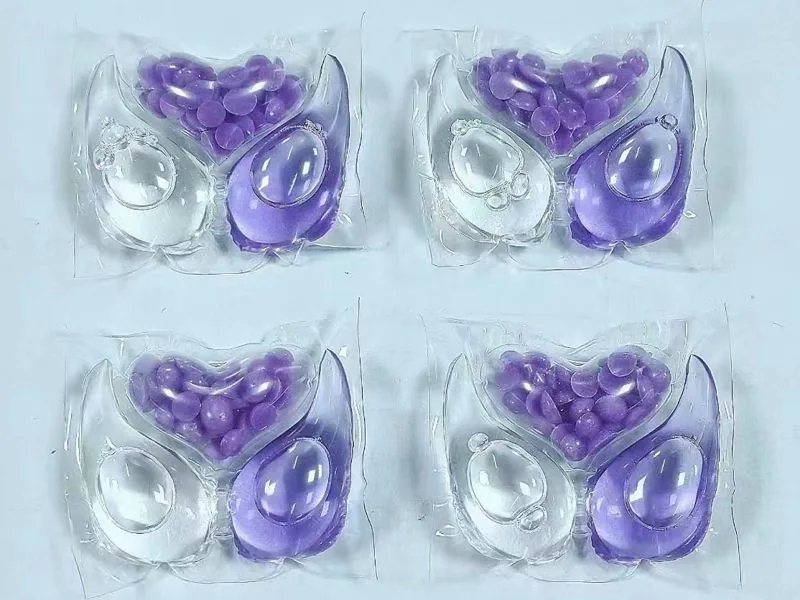
Pod film is the hardest water-soluble specification in the range. It has to carry a wet, chemically active fill for months of storage, survive a customer's damp hand, and then dissolve completely inside a wash cycle — and those three requirements pull against each other.
Three jobs at once
If pod film fails, it is almost always because one of these three requirements has been traded away for another:
- Contain a wet fill. Unlike a dry powder, liquid detergent is in contact with the film from the moment of filling. Over months, an incompatible fill softens seals, bleeds through the film, or migrates to the surface.
- Survive storage and handling. A pod sits in a cabinet, or in a humid bathroom, or in a laundry room. It gets picked up with wet hands and moved between boxes. Film that is tuned purely for fast dissolving tends to fail here.
- Dissolve completely in the wash. Residue is visible to the customer, and an invisible film fragment on dark clothing is the classic complaint. Dissolution has to complete, not nearly complete.
Pod film sits at the warm-water end of the grade range — typically 40–60 °C — because that is what most domestic wash programmes actually reach. The engineering interest is in everything else.
Dissolving in a real wash cycle
Lab dissolution and domestic dissolution are not the same test. Four variables decide what happens in a real machine:
- Programme temperature. A 40 °C programme is not held at exactly 40 °C. Water enters cold, heats over time, and the film meets the fill water first — during the minutes when the machine is coldest. Film specified at "40 °C" therefore needs to begin dissolving below 40 °C, which is one reason the grade alone never settles a specification.
- Time in the wash. Quick and delicate cycles give the film far less time than a standard cotton cycle. A pod sold into markets where short cycles dominate needs a faster-dissolving answer than the same pod sold where long cycles are the norm.
- Water hardness. Hard water slows PVA dissolution. In hard-water regions, a film that dissolves cleanly in soft water can leave residue — and the customer will report it as a product defect rather than a water chemistry issue.
- Load and agitation. Film needs movement and water flow around it. An overloaded drum, or a pod that ends up trapped inside a folded sheet, dissolves noticeably more slowly than one dropped loose into an empty drum.
Water temperature at the customer's tap also varies by market and season, from cold groundwater in northern Europe to much warmer supply in other regions. If your product sells across several markets, the film is often specified for the coldest significant market rather than for the average.
Seal strength and filling machines
Pod film is not judged in isolation. It is judged on a filling machine, and the machine has opinions.
The film passes through a forming and sealing process where the seals are made under heat and pressure (with or without water, depending on the machine type). Three things have to line up:
- Seal integrity. The seal has to be strong enough to hold the fill without weeping, and clean enough to open reliably in wash water. A weak seal leaks in storage; an over-sealed pod leaves a film pocket that does not dissolve cleanly.
- Machine compatibility. Film is supplied to a specification that matches the filling line's sealing parameters and its web handling. Change the machine, or change the film, and the parameters usually have to be re-established — this is normal and worth planning for, not a sign that something is wrong.
- Consistency roll to roll. High-speed filling lines are unforgiving of variation in film thickness, slip properties or moisture content. Consistency across a batch is a bigger commercial issue than any single property being optimised.
If you are setting up a new line, tell us the machine model and its sealing parameters during the enquiry. It is much easier to specify film that suits the machine than to tune a machine around a film.
These formats get grouped together, and they are different projects.
| Multi-chamber pod | Single-dose liquid pouch |
|---|
| Fill | Two or more compartments, often different formulations that must not mix before the wash | One fill, usually a single liquid or gel |
| Film demands | Compatibility with each fill separately, plus barrier behaviour between compartments | Compatibility with one fill, plus a reliable seal on a simpler geometry |
| Filling line | More complex: forming, filling and sealing in sequence, with tighter tolerance | Simpler converting and filling |
| Typical enquiry | Brand owners with an established product shape looking for film supply | Brand owners, contract packers and industrial users of dosed liquids |
If you are still choosing between the two, the fill chemistry usually decides it. Two components that must stay separate until the wash point towards a multi-chamber pod; a single component with a straightforward dose points towards a pouch, which is cheaper to fill and to seal.
What brand owners check first
Before you commit to a film specification
- Fill compatibility over time, not on day one. A storage trial at realistic temperature, not a quick lab check.
- Dissolution in the cold part of the cycle, in hard water, at the load the customer actually uses.
- Residue, on dark fabric, at the end of the shortest cycle you intend to sell into.
- Seal strength after storage, not just at the filling line.
- Humidity behaviour: how the pods cope in a bathroom and in a humid warehouse, and what the retail pack does to slow that down.
- Machine consistency: whether the film's thickness and slip properties hold up across a full production run.
Sampling and scale-up
Pod projects are sampled, always, and the sample is tested by the customer rather than approved on the basis of a datasheet.
We start from what you are filling and how it will be washed, produce film samples in the grade and thickness we believe fit, and you run them on your own filling line and in your own wash conditions. Where the fill is a liquid, we also want to see it after realistic storage, because that is when incompatibility shows up.
From there the discussion becomes commercial: the film specification that passed the tests, the packing format for the film rolls, the volumes involved and the delivery schedule. The same front-loaded sampling process runs behind every product we make — you can see how it works in practice for fishing bait bags and agrochemical dose packs as well.
If you are at an earlier stage — still choosing between a pod and a pouch, or still fixing the fill — say so. We would rather help you pick the format that will work than quote a film for a format you will change in three months.
Sources and standards
Primary sources for the rules and test methods referred to in this guide:
Quick answers
The questions buyers ask most about this topic.
What film is used for detergent pods?
Pods use water-soluble PVA film in a warm-water grade, typically designed for around 40-60 °C, because domestic wash programmes usually run at those temperatures. The exact formulation and thickness are set by the fill, the storage conditions and the shortest wash cycle the product will be sold into, and are confirmed on samples rather than on a datasheet.
Why does my pod leave a film residue on clothes?
Usually the film is dissolving too slowly for the real wash conditions - cold fill water in the early part of the cycle, hard water, a short programme, or an overloaded drum with poor water flow. Residue is generally a specification issue rather than a batch defect. Tell us the programme temperature, cycle length and water hardness you sell into and we will sample a faster-dissolving film.
Will the film work with my existing filling machine?
It needs to be matched to it. Film is specified to suit the sealing parameters and web handling of your line, and if either the machine or the film changes, the parameters usually have to be re-established. Give us the machine model and its sealing settings during the enquiry so we can specify film that suits the machine rather than the other way round.
How long can filled pods be stored?
It depends on the fill and the storage climate. The film has to contain a wet, active fill for months without softening seals or bleeding, and that compatibility should be established in a storage trial rather than assumed. Retail packing that keeps humidity out also matters, because PVA film is hygroscopic.
Can you supply film for single-dose liquid detergent pouches as well as pods?
Yes. Single-dose pouches use the same warm-water PVA film family but with a simpler geometry and sealing requirement. They are usually cheaper to fill and seal than multi-chamber pods, so if your formulation is a single component the pouch format is often the more economical answer.
 Sainsun PVA