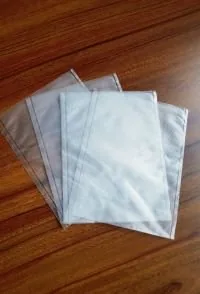
In agrochemicals the pack does two jobs at once: it contains a measured dose and it disappears into the spray tank with the product. That second job is a film engineering problem, and the formulation inside is what makes it difficult.
Why the pack becomes the dose
Handling concentrated agrochemicals is the part of the job that carries real risk. Measuring out a liquid concentrate or weighing a powder in the field means opening a container, transferring product, and dealing with the residues on the measuring equipment afterwards. A water-soluble pack removes almost all of that: the operator takes a sealed dose pack, drops it into the spray tank, and the film dissolves with the product. No pouring, no rinsing out a measuring jug, no contaminated empty container to dispose of.
The operational benefits follow from that:
- Dose accuracy. The dose is fixed at packing. Field measurement error stops being a variable.
- Less operator contact. The concentrate is never open in the field.
- No rinsate problem. No triple-rinsing of small containers and no contaminated packaging to manage afterwards.
- Cleaner inventory. Pre-portioned packs are easier to count, store and account for than bulk containers.
The real constraint: what is inside the pack
PVA film has to survive the product it is holding. This is where agrochemical projects are won or lost, and it is worth being direct about it.
| Fill type | How the film behaves | What it means for the specification |
|---|
| Dry powders and granules | Most straightforward. The film is doing a containment job with little chemical interaction | Thickness set by pack weight and handling; grade set by the water temperature of the spray tank |
| Water-dispersible granules | Usually workable, but some formulations carry residual solvents or surface-active components | Sample with the exact formulation, not a generic powder |
| Liquid concentrates | Hardest case. Solvent-based concentrates and some surfactant-heavy formulations attack PVA film from the inside | Compatibility is formulation-specific and must be established by testing. There is no shortcut |
| Water-based liquids | Depends on water content and the other ingredients — a wet fill is in contact with the film from the moment it is packed | Needs the longest sampling window and a realistic shelf-life test |
The pattern to notice is that dry is easier than wet, and that a formulation change — a different solvent, a different surfactant package, a reformulation for a new market — can invalidate a film that has worked for years. When a customer reformulates, we re-sample. That is not caution for its own sake; it is the one thing that reliably prevents a production run failing at the filling line.
Print, pictograms and batch identification
Agrochemical packs are regulated products, and the printed pack is part of the compliance surface, not decoration. In practice the print carries product identification, dose information, hazard pictograms and a batch or production code.
Water-soluble film prints differently from conventional film, and the honest constraints are worth stating up front:
- Coverage and legibility. Fine detail and thin hairlines are harder to hold on a dissolving film than on a laminated one. Hazard pictograms need to stay readable, so they are usually printed at a size and weight that survives the process.
- Ink compatibility. The ink system has to be compatible with the film and with the product's shelf life — it must not offset, smear or interfere with dissolution.
- Code area. Batch and date coding needs a reserved, consistently placed area to keep the printing line reliable.
- Fill level visibility. If the pack is clear, the fill is visible and that is a quality check in itself; if it is printed, the print should not be over the area you want to inspect.
Send your artwork, or the elements that have to appear, with the enquiry. Print drives tooling and price more than most customers expect, and it is better to design for the film than to discover the constraint after artwork approval.
Shelf life and storage
Two clocks run at once on a filled agrochemical pack: the product's shelf life and the film's. Both matter.
- Moisture. PVA is hygroscopic. Filled packs need a moisture barrier around them — a liner, a sealed carton, or both — for any storage longer than a few weeks, and especially in humid climates.
- Internal attack. A wet or aggressive fill softens seals and weakens the film over months. Where the fill is liquid, the practical shelf life of the pack is usually the number to establish first.
- Stacking and abrasion. Film packs are softer than rigid containers. Carton design should carry the stacking load rather than the packs themselves.
- Temperature. Hot storage accelerates everything — film ageing and product degradation alike.
We will tell you what we can support and what needs to be tested by you on the finished pack. Realistic shelf-life data comes from a real storage trial, and we would rather say that plainly than quote a number we cannot stand behind.
One thing we will not do: give you regulatory advice. Pesticide registration, packaging rules and labelling requirements differ by country and change over time. We build the pack to your specification and can support your registration file with technical information about the film — but the compliance position is a question for your regulatory advisor in each market, and it should be settled before artwork is finalised.
What to send us for a sample
For an agrochemical project we need
- The formulation, or its type. Dry powder, granule, water-dispersible granule, water-based liquid or solvent-based concentrate — plus, if possible, a small physical sample for compatibility testing.
- Dose weight or volume per pack, and the tolerance your registration allows.
- The tank water. Typical temperature, and whether the water is hard. Dissolution varies with both, and spraying water is rarely as clean as lab water.
- Dissolving window. How long the pack may take to dissolve in the tank, with the agitation the tank actually provides.
- Print and coding requirements, including pictograms and where the batch code must sit.
- Storage and shelf-life target, plus the climate the finished packs will be stored in.
- Market and regulatory framework, so we know what documentation you will need from us.
With those points we produce samples in a film we believe is compatible, and you test them with the real formulation, in real tank water, at real dose weights. Where the fill is a liquid concentrate, expect to test over time rather than a single afternoon — compatibility problems often appear weeks into storage rather than on day one, which is exactly why we build the sampling stage into the schedule at the start.
 Sainsun PVA