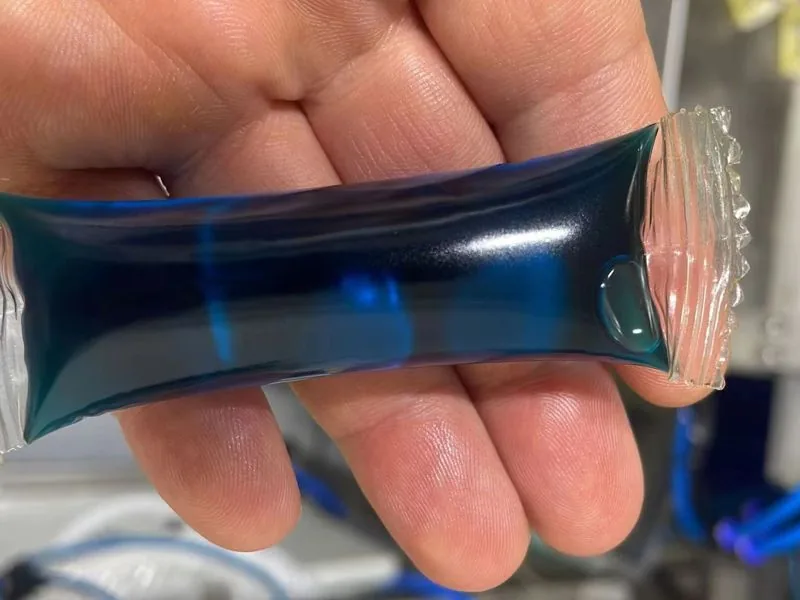
A liquid dose is harder on film than a powder dose. The film is under constant load, the seal is under constant pressure, and the contents are often aggressive. The pack has to hold for months and then disappear in one wash.
Water soluble pods packaging, from film to filled pack
Search "water soluble pods packaging" and you will find two kinds of supplier: film mills that sell rolls, and converters who buy film and fill packs. We are the second kind, with the first kind built in — the same factory casts the film and makes the finished pods, so the film grade, thickness and seal window are not guesswork. That matters for pods packaging because most complaints (leaking, residue, film blocking) trace back to a film-to-filling mismatch, not to the film itself.
We supply three formats: pre-filled water soluble sachets packaging for liquids and gels, empty pod film rolls for brands filling in-house, and water soluble polybags for larger industrial doses. All three are covered by the same compatibility test: your product, our film, 30 days of storage at 40°C, then a dissolve check at the target water temperature.
What a single-dose liquid pouch is
A single-dose liquid pouch is a sealed water-soluble film pack holding one measured dose of liquid, gel or concentrate. The user drops the whole pack into the wash, the tank or the process water. The film dissolves and releases the dose with no measuring, no spillage and no packaging waste to dispose of.
For brands, the appeal is accuracy and convenience. For the film, it is the hardest job in the water-soluble category — a liquid load never stops pushing against the film and the seal.
Where it is used
- Laundry and fabric care — single-dose detergent, softener and booster concentrates.
- Cleaning and hygiene — unit-dose disinfectant, sanitiser and floor-care concentrates.
- Agriculture and horticulture — measured liquid nutrient or crop-treatment doses.
- Industrial dosing — pre-measured liquid additives where manual measuring is a safety or cost problem.
What we make
| Specification | What we supply |
|---|
| Film grade | Warm-water PVA, 40–60 °C, matched to the process water your user works with |
| Format | Finished pouches, or film in rolls for your own form-fill-seal line |
| Dose size | Made to your fill volume and pouch dimensions |
| Seal strength | Film supplied to a seal window agreed with your machine and your fill |
| Barrier | Film selected for the aggressiveness of the fill — water-based, surfactant-heavy or solvent-containing |
| Print | Plain film, or printed with branding and dosage marks |
What to specify when you enquire
Liquid fills need more information up front
- Fill volume and pouch dimensions
- What the liquid is — water-based, surfactant, solvent, acidic or alkaline
- Water content of the fill, including any free water
- Process water temperature where the pack will be used
- Storage time and conditions before use
- Your filling and sealing machine, and its seal parameters
- Print requirement and target quantity
Why liquid fills are harder on film
Powder sits in the pouch. Liquid pushes against it — hydrostatic pressure on the seams, and continuous contact between the fill and the inside surface of the film. Water-based fills can migrate into the film over time, softening it and weakening the seal. Some surfactants and solvents attack the film directly.
The result is that a formula which works perfectly for a powder pod can fail in weeks with a liquid fill. The film, the plasticiser level and the seal window have to be selected together, and tested with the actual fill rather than water.
Common mistakes
- Sampling with water instead of the real fill. Water is the mildest thing you can put in a pouch. The real formulation is what decides whether the film survives.
- Ignoring free water in the fill. Even a small free-water content keeps working on the film for the whole shelf life.
- Over-thin film to hit a dissolving speed. Thin film dissolves fast but bulges and leaks under liquid load.
- Not testing the seal, only the film. Most liquid-pouch failures happen at the seam, not in the film body.
How ordering works
Send the fill formulation or a description of it, the dose size and your machine details. We reply within 24 hours with a film recommendation, a sample plan and timing. You test the samples with your actual fill on your own line. Bulk production starts only when the pack performs as agreed.
Related reading
For how film grades are matched to process water, read PVA film grades: cold, warm or hot water?. For the grading criteria brand owners apply to pod and pouch film, see Detergent pod film: what brand owners check first. If you also pack powder doses, our detergent pod film page covers grade selection; for infection-control laundry, see water-soluble laundry bags.
Quick answers
The questions buyers ask most about this application.
Can water-soluble film hold liquid without leaking?
Yes, provided the film and the seal are specified for a liquid fill. The film sits under constant load from the liquid, so thickness, plasticiser level and seal window are set together and tested with your actual fill rather than with water.
What film grade is used for liquid pouches?
Warm-water PVA film, 40–60 °C, matched to the process water temperature where the pouch will be used. If the pack is designed for a cold or eco wash, the film has to be specified for that instead.
Which liquids are not suitable?
Strong solvents, highly acidic or alkaline fills, and formulations with a high free-water content are the difficult cases. Send us the formulation or a description and we will tell you honestly whether PVA film is the right route or not.
Do you supply film in rolls as well as finished pouches?
Yes. We supply film in rolls — width, core size and length to your line — for customers who fill and seal on their own machine, as well as finished pouches.
How do I test before a bulk order?
Sampling is the first step of every project. We agree a sample plan with you, you fill and seal the samples with your own product on your own line, and bulk production only starts when the pack performs as agreed.
What is the minimum order quantity for liquid pouches?
MOQ starts at 1,000 pcs for custom PVA bags; size, film grade and printing can move it, so the exact figure is confirmed in the written quotation. Send your target quantity with the enquiry and we confirm the exact minimum, unit price and lead time in the written quote.
Can I test the pouches with my own liquid before a bulk order?
Yes. Samples are the first step. You test the film with your own liquid, at your own concentration and temperature, and bulk production starts only once the film performs as agreed.
How long does production take?
Sampling comes first, then bulk production, quality check and shipping. Exact lead time depends on pouch size, film grade, print and quantity and is confirmed in the written quote.
What information do you need to quote a liquid pouch?
The liquid or gel and its concentration, the fill volume, the process or use temperature, whether the pouch is printed, and your target quantity. With those we confirm film grade, pouch size, unit price and lead time.
 Sainsun PVA