 Sainsun PVA
Does PVA film dissolve completely?
Yes, when the grade matches the water temperature and there is enough time and agitation. A complete dissolution leaves the water as dissolved polymer, with no solid film or fragments left behind.
A fully dissolved PVA film leaves no microplastic fragments: the film goes into solution as dissolved polymer instead of breaking into solid pieces. The open question is what happens next — dissolved PVA biodegrades only where the right microorganisms and conditions exist, which is why residue testing on your own process matters before any claim is made.
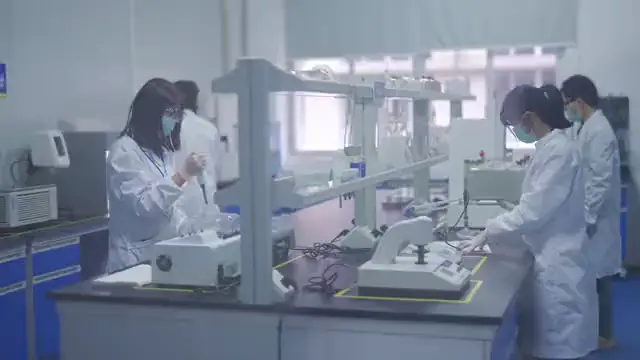
The microplastics question reaches us from detergent brands, agrochemical buyers and hospital laundry managers, usually after someone upstream has repeated a social-media claim about “plastic dissolving into the wash”. It deserves a straight answer, and the straight answer has two parts: what dissolution physically is, and what biodegradation of the dissolved polymer requires. Confusing the two is where most of the online argument goes wrong.
A microplastic is a solid fragment — a piece of plastic small enough to pass through treatment systems and persist as a particle. Dissolution is a different process: the polymer chains separate into the water as individual molecules, the same way sugar dissolves. A film that dissolves completely leaves no solid material to sieve out of the water, so the end state of complete dissolution is a solution, not particles. That is a property of the material, not a processing trick: polyvinyl alcohol is engineered with hydroxyl groups that hydrogen-bond with water, which is why the film lets go entirely rather than shedding fragments.
It can, but not instantly and not everywhere. PVA is a biodegradable synthetic polymer: microorganisms that produce PVA-degrading enzymes break the dissolved polymer down further. The honest caveat is that the rate depends on the microbial community, the temperature and how acclimatised that environment is — acclimatised biological treatment breaks it down reliably, while cold seawater with no adapted microbes may not, at least not on a human timescale. So the accurate claim for a buyer is “dissolves completely and is biodegradable under suitable conditions”, not “vanishes into nothing”. We would rather our customers make the narrow claim than the broad one.
Test with your own product and your own water. A residue test is simple: dissolve a sample at the temperature, hardness and agitation your process actually reaches, then check for undissolved film, gel lumps or cloudiness — the method is written up in cold-water residue testing. Residue is not microplastic — an undissolved piece of film is a visible, recoverable sheet, not a dispersed particle — but residue in a wash water or a spray tank is still a quality failure, so the test earns its place in every qualification run.
The two solve the problem at different stages. Biodegradable film stays solid through use and breaks down later, under composting conditions that must actually exist; until then it is a solid object in the waste stream. PVA film removes itself at the point of use — the pack disappears in the water, and what leaves with the wash is dissolved polymer awaiting biodegradation. The full comparison, including where each material fails, is in PVA versus biodegradable film.
Match the grade to the water your process actually uses, then confirm on samples. Cold-water film dissolves at 20-30 °C, warm-water at 40-60 °C, hot-water at 70 °C and above; thickness is set between 30 and 100 µm per application, and time and agitation finish the job — the variables are set out in what decides PVA film dissolve time. Samples are free for your own testing and normally ready in about 1 week; bulk orders start at MOQ 1,000 pcs, with unit price and lead time in the written quotation. Capacity behind that is about 40 tons of PVA film a month (verified November 2026), cold-water film being the main grade; the ranges sit on the PVA film specifications page.
Yes, when the grade matches the water temperature and there is enough time and agitation. A complete dissolution leaves the water as dissolved polymer, with no solid film or fragments left behind.
No. A microplastic is a solid particle; dissolved PVA is polymer in molecular solution. The distinction is physical, and it is why dissolved film cannot be sieved out of the water.
Not reliably. Biodegradation needs microorganisms that produce PVA-degrading enzymes, and cold water without an adapted microbial community may not break it down on a useful timescale. Make the narrow claim, not the broad one.
MOQ starts at 1,000 pcs for custom PVA bags. Samples are free for your own testing and normally ready in about 1 week; film runs 30-100 µm and capacity is about 40 tons a month (verified November 2026).
The questions buyers ask most about PVA film and microplastics.
Yes, when the grade matches the water temperature and there is enough time and agitation. A complete dissolution leaves the water as dissolved polymer, with no solid film or fragments left behind.
No. A microplastic is a solid particle; dissolved PVA is polymer in molecular solution, which is why dissolved film cannot be sieved out of the water.
Not reliably. Biodegradation needs PVA-degrading microorganisms, and cold water without an adapted community may not break the dissolved polymer down on a useful timescale.
Dissolve a free sample at the temperature, hardness and agitation your process actually uses, then check for undissolved film, gel lumps or cloudiness. Samples are normally ready in about one week.
MOQ starts at 1,000 pcs for custom PVA bags, with film thickness set between 30 and 100 µm and roughly 40 tons a month of capacity behind the quotation (verified November 2026).
Send your product, bag size and target quantity. We reply with a film recommendation, a sample plan and a quote within 24 hours.
Chat on WhatsAppor send the form — we reply within 24 hours