Between 30 and 100 microns — and inside that range the number is set by what the pack carries, how fast it has to dissolve and how it is filled. Thin film dissolves faster and uses less polymer; thicker film carries more weight and survives sharper fill. The gauge is confirmed on samples, not in a catalogue.
What thickness range do you actually produce?
Our water-soluble film runs from 30 to 100 microns, and the exact gauge is set per application inside that window. The sequence matters: the dissolving grade is chosen first, because temperature decides which polymer you are working with — cold-water film dissolving at 20–30 °C, warm-water film at 40–60 °C, hot-water film at 70 °C and above. Only then does thickness get fixed, because the gauge has to serve both the product inside and the water it will meet.
Master rolls are slit to the width each filling line needs, so width does not constrain the gauge question, and the cold-water grade is our main line at roughly 40 tons of film a month. Grades and what is specified per project are on the film specifications page.
What pushes a pack to the thicker end?
Thickness is a strength decision before it is a barrier decision. The usual drivers:
- Payload mass. A heavier fill loads the seams and the film itself. A sachet holding a few grams and a bag holding a kilo do not need the same wall.
- Liquid payload. A liquid pushes outward on every square centimetre of film and puts a standing head of pressure on the bottom seal. Powder does not do this, which is why single-dose liquid pouches sit at a different gauge from a powder sachet.
- Sharp or crystalline fill. Agrochemicals, dye powders and granular products have edges. Thicker film buys margin against punctures created during filling and in transit.
- Print coverage and handling. Heavily printed film is handled more, rewound more and pulled through more stations before it becomes a bag.
- The machine. Film is drawn, heated and sealed on your equipment. A film that is too thin for the draw depth or the seal bar will fail on the line, not in the lab.
When can the film be thinner?
Four situations lean thin: a short dissolve window, a light payload, a small single-use format, and a cost target where polymer per pack matters. Thin film dissolves faster simply because there is less material to clear, and it uses less polymer per square metre.
The trade-off is margin. Thinner film gives you less protection against pinholes, less tolerance for a contaminated seal face, and less forgiveness in a hot warehouse.
Does thickness change how fast the film dissolves?
Yes, directly: the water has to work through more polymer. But thickness is rarely the dominant variable in the field. Water temperature, dissolved solids in the water and agitation usually move dissolve time further than one step in gauge, which is why a film that tests clean in a lab beaker can leave residue in a cold wash. The variables are set out in what decides PVA dissolve time, and the test method for a cold supply in cold-water residue testing.
How do I settle the number before a bulk order?
With samples in your own water, at your own temperature, on your own machine, with your own product. Samples are provided free for your testing and are normally ready in about one week. What to check, in this order:
- Dissolve and residue. Full clearance, no film left in the corners or seams, at the temperature your process actually reaches.
- Seal strength. Sealed on your equipment at your settings, then opened by hand and pulled — a seal that peels cleanly at the edge is the failure that reaches customers.
- Survival in transit. Store filled packs the way they will be stored and shipped, then look for pinholes and soft spots.
- Print. If the film is printed, check that the ink and the gauge still dissolve together — coverage is not cosmetic on a water-soluble pack.
MOQ for custom PVA bags starts at 1,000 pcs, and production starts once all details are confirmed. If the gauge or the grade needs adjusting after your test, that happens before the bulk run, not after it.
Can you print and convert at that thickness?
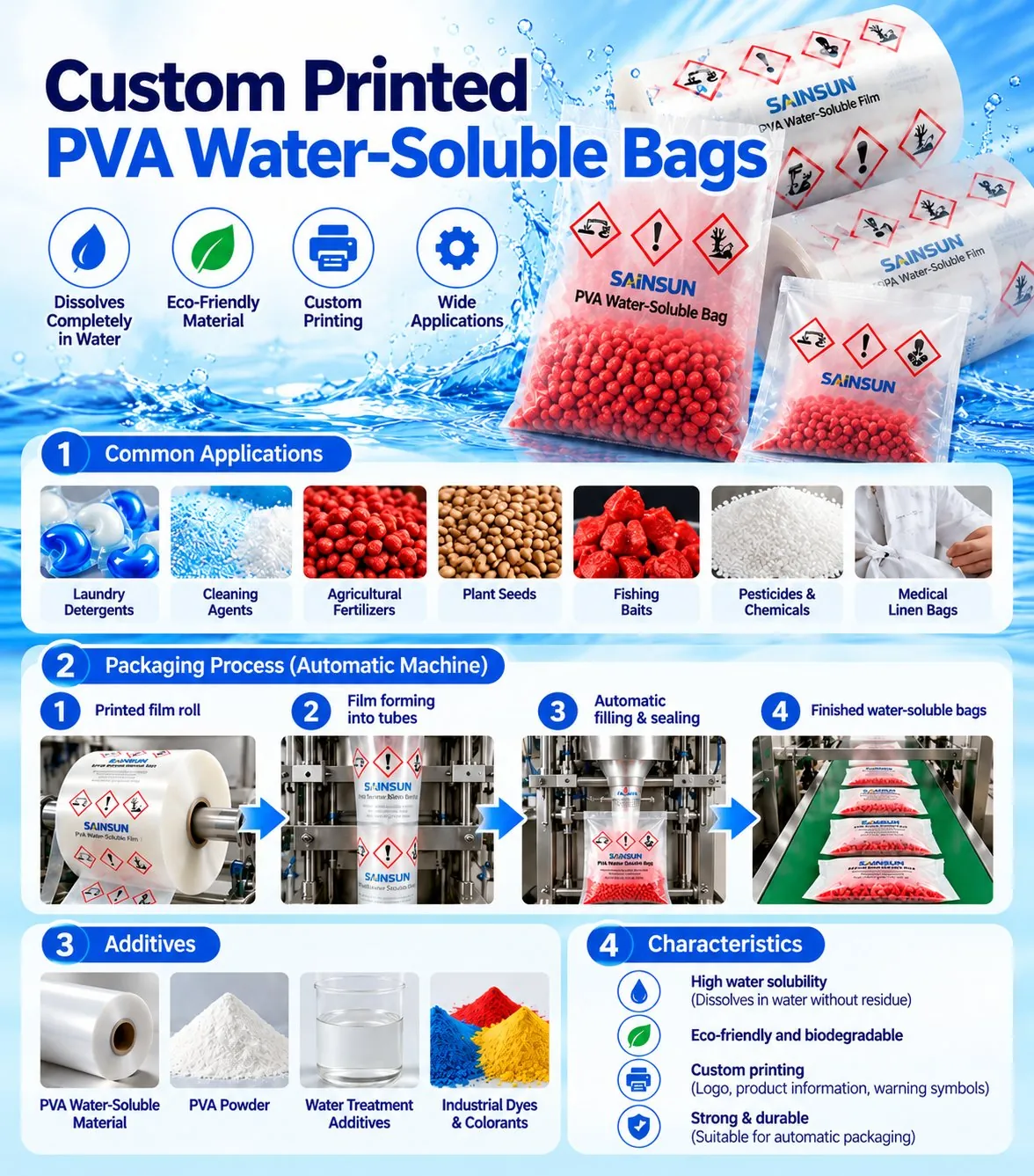
Yes. Every order is made to the customer's bag size, film thickness, dissolving temperature and print, and printing includes hazard pictograms for agrochemical packs, with the print agreed against the dissolving behaviour the pack has to hit. Film is supplied in rolls for customers who fill on their own lines, as finished bags for customers who want a ready pack, and there is an OEM filling service for customers without automatic filling equipment. The printed route is described on customized printed PVA film.
Quick answers
What thickness PVA film do you make?
Between 30 and 100 microns, set per application inside that range. The dissolving grade (cold 20-30 C, warm 40-60 C, hot 70 C and above) is chosen first; the gauge follows from the payload and the dissolve window.
Does thicker film dissolve more slowly?
Yes, there is more polymer to dissolve in the same area. But temperature, dissolved solids and agitation usually move the dissolve time further than one step in gauge, so both have to be tested together.
Can I get the film thinner to save cost?
Sometimes. Thin film uses less polymer and dissolves faster, but it leaves less margin for pinholes, seal contamination and rough handling. Test it, do not assume it.
What is the minimum order and sample time?
MOQ for custom PVA bags starts at 1,000 pcs. Samples are free for your own testing and normally ready in about one week; production starts once all details are confirmed.
 Sainsun PVA