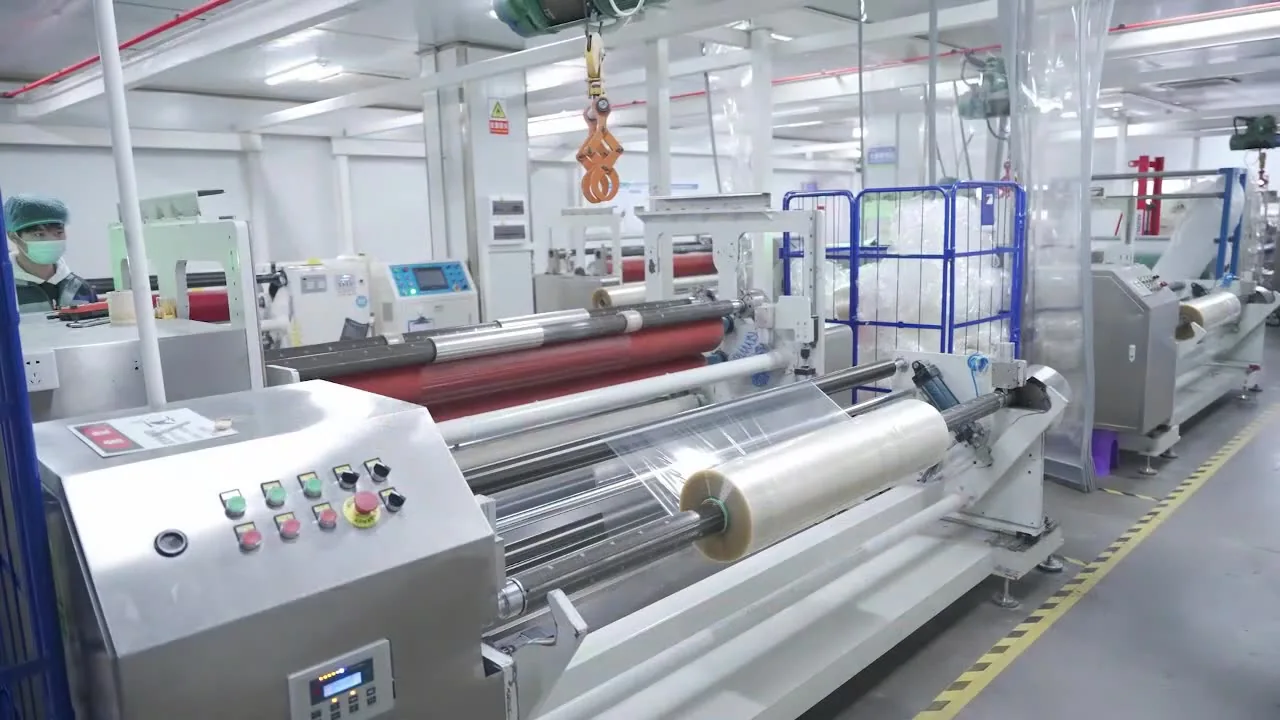
Short answer: buy film in rolls if you already own a form-fill-seal machine and can keep the film dry; buy finished bags if you fill by hand, run small launches, or want one supplier to fill as well as convert. The film, the grade and the print are the same either way — what changes is who forms the pack, and who carries the risk when it does not run. Every order we make is built to the customer's bag size, film thickness, dissolving temperature and print, whether it leaves the factory as rollstock or as a sealed pouch. Here is how the two routes actually differ, what a roll specification has to contain, and the failures that only appear on one side of the choice.
Film in rolls is material, not packaging: you receive film at a stated width and gauge, and your machine forms the pouch, doses, seals and cuts it. Finished bags arrive converted — pocket, seal and print done — and the only step left is filling.
What is the difference between film in rolls and finished bags?
- Rolls — film at your roll width, thickness and core size, with print registered to your machine. Your line does the converting.
- Finished bags and pouches — converted to your bag size, film thickness, dissolving temperature and print, ready to fill on your side or ours.
The chemistry does not change with the format: cold-water film dissolves at 20–30 °C, warm at 40–60 °C, hot at 70 °C and above, chosen against your process — only the mechanical work moves.
When does film in rolls make sense?
Rolls are the better route when the filling step is already yours and under control:
- You run a form-fill-seal or pouch-filling machine, and it is set up for water-soluble film.
- One film serves several products, and you want fill weight, dose and pack geometry inside your own process.
- You need print registered to your machine, so artwork lands in the same place on every pack.
- You can store the film sealed and dry, and consume a roll within its shelf life rather than opening it for a seasonal run.
For a roll quote send the roll width, film thickness and core size, plus the dissolving temperature and the print — or send the bag size and the machine and we will advise the dimensions.
What has to be on a roll specification?
| Item | What to state | Why it matters |
|---|
| Roll width and core | Width in mm and core diameter for your mandrel | A roll that does not mount is scrap before it is opened |
| Gauge | Film thickness, and the tolerance you accept | Dissolving time moves faster than thickness does |
| Dissolving band | Cold 20–30 °C, warm 40–60 °C or hot 70 °C+ | Set by your water temperature, not by film strength |
| Print and registration | Artwork, colour, coverage and the repeat your machine needs | Ink sits on the surface the water has to reach |
| Packing way | Sealed bag inside the carton, roll per bag, quantity per carton | The packing is the moisture barrier, not the carton |
Printing deserves its own line. Printed film is supplied in rolls with registration matched to your machine, or as finished printed bags and pouches, and coverage is agreed against the dissolving behaviour the pack has to hit. The detail is on our customized printed film page.
What goes wrong with rolls that does not happen with bags?
The first failure is blocking. PVA is hygroscopic, and a roll exposes far more surface than a sealed bag does; once the outer wraps take up moisture they weld together and the roll will not unwind, at which point it is a stoppage rather than a reject you can pick around. Our guide to blocking and shelf life sets out the arrival check and the storage window to plan against.
The second is the machine: a new gauge or formulation changes how the film runs over the seal bar and through the rollers, so seal settings belong in the trial, not in the purchase order.
When do finished bags or OEM filling make sense?
Finished bags are the simpler route when you do not want to own the converting step: no machine to buy, no seal parameters to develop, no roll to store. That covers a first launch, several pack sizes, a liquid dose where pouch geometry is the hard part, and any market needing hazard pictograms printed as part of the artwork.
If you have no filling machine, our factory can fill as well as convert. Send the material to be filled, the pack weight or volume and the target quantity: we run a compatibility test first, because high free moisture, strong alkalinity or acidity and some solvents can soften the film from the inside; then we fill sample packs for your approval and, on approval, fill, seal and pack the bulk order so you receive ready-to-use packs. The split of work is on the OEM filling page, and the minimum is confirmed in the quote.
We have been making bags for 18 years and exporting since 2017, converting film into packs in our own factory in Huizhou — so the people who quote the roll also run the machine that would fill it.
How do you validate either route before a volume order?
- Run it at your own water temperature. Samples are provided free for your own testing; a jar at the temperature your process reaches beats a datasheet figure.
- Run it on the machine, if you have one. Twenty packs across the conditions you really run show whether gauge and seal settings agree.
- Check the gauge received against the gauge approved. Dissolving behaviour is quoted against a thickness; a substitution is a different product.
- Keep a roll in your own store through the season. That is how you learn how the film behaves in your warehouse, not ours.
MOQ starts at 1,000 pcs for custom PVA bags; unit price and lead time are confirmed in the written quotation, because both depend on the pack. Send the product, pack size and target quantity for a recommendation, a sample plan and a price.
Quick answers
The questions buyers ask most about this topic.
Is film in rolls cheaper than finished bags?
Not as a rule, and price is the wrong place to start. Unit price depends on pouch or bag size, film thickness, print coverage and quantity, so it is confirmed per project in the written quotation. Rolls remove the conversion step, but they add a machine, seal settings and moisture control on your side.
What do I need to send for a film roll quote?
Roll width, film thickness and core size, or the bag size you need if you would rather we convert. Add the dissolving temperature band, print artwork and coverage, target quantity and destination market. From those we can quote and send samples for your own testing.
Can you print film for our own filling machine?
Yes. Printed film is supplied in rolls with registration matched to your machine, and printing is agreed against the dissolving behaviour the pack has to hit. The same artwork can also be supplied as finished printed bags and pouches.
Our roll arrived soft or blocked - was the grade wrong?
Usually not. PVA is hygroscopic: the film took up moisture in transit or storage, and the wraps welded together. Check the sealed bag inside the carton, the humidity it was stored at and how long it sat there before blaming the grade. Our blocking guide sets out the storage window to plan against.
We have no filling machine - can you fill the packs?
Yes. Send us the material to be filled, the pack weight or volume and the target quantity. We run a compatibility test, fill and seal sample packs for your approval, then fill, seal and pack the bulk order so you receive ready-to-use packs.
 Sainsun PVA