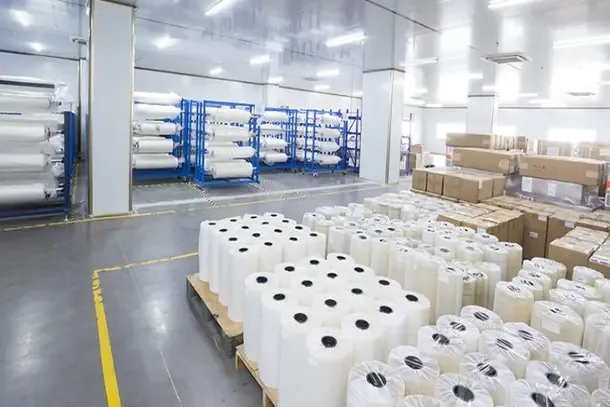
PVA film that arrives soft or blocked is not a manufacturing defect in most cases: it absorbed moisture in transit, and the wraps welded together because the film's surface had plasticiser on it and the container crossed air the data sheet never described. The failure therefore starts at packing — a sealed bag inside a container is the specification, and a container that sat in a humid port for three weeks with a compromised bag will block regardless of grade. This guide covers how blocking develops, the packing and storage conditions worth writing into an order, and how to tell transit moisture damage from a grade that was wrong from the start.
A converter opens a roll six weeks after it shipped and finds the outer wraps fused into a sheet that will not separate. A brand unpacking cartons in a humid season finds the film soft enough to stretch under its own weight. Neither complaint sounds like a sourcing question, and both are: the water came from the air, and the air is the part of the supply chain nobody writes into a purchase order.
The same physics shows up in miniature wherever the film is used. Carp anglers are warned in every beginner guide to store PVA dry, because water vapour "gets around the place" and good PVA is expensive to waste. If a roll cannot survive a damp shed, it cannot survive a container at sea either - the difference is only how much air, for how long, at what humidity.
The film was never waterproof to air
PVA is hygroscopic, and the moisture it takes up does not rise evenly with humidity. Peer-reviewed sorption data for cast PVA film at 25 °C show a knee in the curve: between roughly 57% and 75% relative humidity, each additional percent of RH adds about 0.4 g of water per 100 g of film; between 75% and 84% it is about 1.3 g; between 84% and 97% it is about 4.2 g (Journal of Food Science, 2023 - see sources). Past roughly 75% RH, the same one-percent step in humidity moves about ten times more water into the film than it did below the knee.
That is why the difference between a 60% warehouse and an 85% container is not "a bit more moisture". It is a different regime, and the film looks and behaves differently on the far side of it: tacky surfaces, lost dry strength, sheets that block together. Formulation moves the knee but does not remove it - cold-water grades carry more plasticiser, and it is the plasticiser that takes water first, so a softer, faster-dissolving grade also has the least headroom in humid storage.
The practical consequence for a buyer: the question is never "is the film waterproof" but "what humidity will it see, and for how long". Published converter guidance puts the safe storage zone at roughly 15-25 °C and below about 50% RH, and quotes a shelf life of 12-24 months for sealed, unopened film held there. Those are trade ranges from supplier data sheets, not standardised limits - but they are the ranges the product is actually built to meet.
Blocking: the failure with a test method of its own
The weld-the-outer-wraps failure has a name in the film industry, and it is worth knowing because it can be specified and measured. ASTM D3354-21, the parallel-plate method for plastic film, defines blocking as unwanted adhesion between layers that develops in processing and storage when smooth film sits in intimate contact with the air nearly excluded - and notes that temperature, pressure, or both, induce or change the degree of adhesion. The test expresses the result as the load, in grams, needed to separate two layers over 100 cm² of contact area.
PVA is unusually exposed to this, for two reasons working together. Moisture softens the surface so that two layers in contact behave more like one. And a roll is a machine for applying pressure: thousands of wraps pressing on each other, heaviest at the core, warmest where the pallet sat near a wall or in the sun. Soften the surface and add pressure and heat, and the layers stop being separable. What began as a humidity problem ends as a mechanical one you find with your hands.
"Stuck together" does not have to stay a vague complaint. If blocking matters on your converting line, it can be a specification line - tested, numbered and accepted or rejected on arrival, the same way tensile strength is.
Where the damage actually happens
- The container. Ocean transit typically runs 20-35 days on Asia-Europe routings, and one converter's guidance notes that plain polyethylene bags let film absorb ambient moisture over exactly that span, while temperature swings at sea can push a dry container to 85-90% internal RH. Foil-barrier primary packaging with a desiccant is the countermeasure; a roll shipped in a plain poly bag has no defence but luck (supplier-side guidance, not a standardised figure).
- The warehouse. The wet corners of a building do the same work as the sea, slower: beside dock doors, under AC vents that condense, against walls that sweat, on cold pallets brought into warm humid air where moisture deposits on the film surface directly.
- The opened roll. Converter guidance is blunt about the most common self-inflicted case: a partial roll left exposed overnight in humid conditions loses measurable strength by the next morning, and shows up days later as a web tear on the machine - blamed on the film or the machine, not on the hour it spent open.
- The calendar. The 12-24 month shelf life quoted on data sheets runs from manufacture, not delivery. A roll that spent two months in transit arrives with its clock already run down, and FIFO only helps if somebody can see the dates.
A brand ordering film for detergent pods or agrochemical sachets is buying dimensional stability on a packaging line, where soft film feeds badly and seals variably. The storage question is part of the purchase even though it never appears on the quotation.
A 20-minute arrival check on every batch
None of this requires a lab. It requires a routine that produces evidence on the day the goods arrive, while the packaging still tells its story:
- Photograph before cutting. Outer wrap condition, condensation on the inside of the liner, torn or re-taped bags. This is the first exhibit in any claim.
- Check the humidity indicator. If the supplier packs with humidity indicator cards, read and photograph them. If they do not, that is already information.
- Unwind the first ten wraps by hand. Feel for tack, listen for tearing. Blocking at the outer wraps points to transit moisture; blocking deep in the roll points to storage or to the roll itself.
- Compare against a retained sample. Keep one sealed specimen from every accepted batch. Hand feel and stiffness differences show up immediately against a reference.
- Condition and pull a specimen. Cut a strip, hold it 24 hours at the standard conditioning atmosphere of 23 °C and 50% RH (ASTM D618), then check it against the data sheet tensile figure (ASTM D882 is the method behind most published tensile values). A data sheet number was measured in that atmosphere; film that has lived at 85% RH will not reproduce it.
- Time a dissolution check. Drop a piece of the same roll into water at the grade's rated temperature and compare the time to the dissolve-time behaviour you specified. Moisture-loaded film shifts first in mechanical properties, but a dissolve check closes the loop.
Log the batch with photos, readings and the retained-sample reference. Ten minutes of routine turns a soft roll from an argument into a record.
Put the storage question in the order, not the claim
Most of this failure mode can be bought away from, at enquiry stage, with four lines:
- Ask what storage conditions the supplier will stand behind in writing - RH and temperature limits on the technical data sheet, not verbally. If two suppliers quote different limits, that difference is real information about formulation and packaging.
- Specify the primary packaging. Foil-barrier bag, heat-sealed, with desiccant and a humidity indicator card inside. A plain poly bag is acceptable for a courier parcel across town; for ocean freight it is a red flag.
- Ask for the manufacture date on the packing list and the shelf life remaining at delivery, and agree the claim window in months from arrival.
- Buy against consumption. Trade guidance for humidity-sensitive film suggests ordering roughly 6-12 months of usage at a time; volume buyers with genuinely climate-controlled stores can hold longer, but "holding longer" only counts if the room is controlled, not because the rolls have always been fine before.
Grade choice is part of the same conversation. If your store cannot honestly hold below 50% RH in August, a grade chosen for storage tolerance may cost less per usable metre than the cheapest grade bought twice.
If the roll has already gone soft
Triage before disposition. Outer wraps only: cut away the affected length, keep the core, and re-bag the remainder in a foil bag with fresh desiccant. The whole roll tacky throughout: do not plan to dry it on the line. A roll that took weeks to take water up will not give it back evenly, and fast drying trades tackiness for brittleness and blocking. Test what you have - conditioned specimen against data sheet - and decide on the numbers.
Either way, document: photographs of the packaging as received, humidity readings, batch numbers, retained samples sealed and labelled. Claims turn on evidence of condition at receipt - exactly what the arrival check produces - and a supplier who packs in foil with indicator cards usually expects to be measured on it.
Send us your transit route and your store conditions, and we will quote the packaging that gets the film to your line in the state the data sheet describes - not the state the container describes.
Sources and standards
Primary references for the rules, test methods and figures referred to in this guide:
- ASTM D3354-21 - Standard Test Method for Blocking Load of Plastic Film by the Parallel Plate Method: blocking definition, 100 cm² contact area, load in grams (ASTM)
- ASTM D618-21 - Standard Practice for Conditioning Plastics for Testing: standard conditioning atmospheres and why humidity changes test results (ASTM)
- ASTM D882 - Tensile Properties of Thin Plastic Sheeting: the method behind most film data-sheet tensile figures (ASTM)
- Journal of Food Science (2023) - PVA film moisture sorption isotherms at 25 °C: hygroscopicity rising from ~0.4 to ~4.2 g water per 100 g per %RH as RH climbs past 75% (Wiley)
- Chris Maltby, An Intro to PVA (Big Carp News) - angler storage guidance: keep PVA dry, water vapour "gets around", good PVA is easy to waste
- Polyva - long-term storage guidance for PVA water-soluble film (converter guidance: ~15-25 °C, low RH, sealed barrier packaging, desiccants and humidity indicator cards)
- Haita Water Soluble Film - storage and transit guidance (converter guidance: 20-35 day container transit, plain PE vs foil-barrier packaging, container RH during ocean freight, FIFO and shelf life)
Shelf-life, humidity and transit figures quoted above are trade ranges from published converter guidance and are labelled as such in the text. They are not standardised limits and vary by supplier and formulation. The moisture-sorption figures are from peer-reviewed literature for cast PVA film; specific commercial grades differ.
 Sainsun PVA