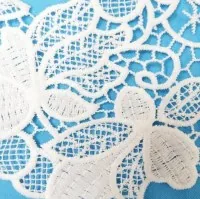
Water-soluble embroidery backing film is specified by two numbers: the thickness that stabilises the stitch, and the water temperature that removes it without leaving a residue on the finished lace. Thicker film supports denser stitching and dissolves more slowly; too thick and the film survives the rinse, too thin and the design distorts before the needle finishes. This guide covers thickness against stitch density, cold versus warm wash-out, and the residue check that decides whether a backing is suitable for a garment that will be worn against skin.
A lace panel comes off the machine perfect. It goes through the rinse, comes out, dries - and the customer feels it before they see it: a stiffness over the stitching and a haze that catches the light. Nobody ordered a film-coated garment, and the complaint that follows is usually phrased as a quality problem with the film.
It is almost never a defective batch. A film that will not rinse out cleanly is usually doing exactly what it was specified to do, at a temperature, a thickness and a rinse method that were never agreed. Finding out which of the three is wrong costs less than arguing about a batch, and it is the difference between fixing the line and repeating the same defect with the next supplier.
Two different defects get called the same thing
Separate them first, because the causes and the fixes are not the same.
- Film that never fully dissolved. The piece feels slightly stiff, and there is a translucent haze behind the stitching that becomes obvious once the fabric is dry. This is the classic failure of a hot-water film in a rinse that never got hot.
- Film that dissolved and then came back. A workshop that rinses in a bowl instead of under running water leaves dissolved polymer sitting around the piece, and it redeposits onto the stitches and the fabric. Trade guidance on stabiliser removal is consistent on this: rinse under running water, and trim away excess film before it ever gets wet.
There is a third case worth ruling out early, and it is a sourcing problem rather than a process problem. Not every sheet sold as wash-away backing is fully water-soluble. Tear-wash hybrids soften in water but contain fibres that do not dissolve, and those leave a papery film that extra rinsing will not remove. One scrap test settles it: drop a piece from the same roll into warm water, agitate it, and look at what is left. If there is pulp or fibre, you are rinsing the wrong product.
The grade has to match your rinse, not your machine
Embroidery film is graded by the water temperature it dissolves in, and the gap between grades is far wider than most buyers expect. We supply embroidery backing film as a hot-water grade rated for 70 °C and above: enough body to hold a dense design through the run, and complete dissolution in a hot rinse. Cold-water grades sit at the other end of the range and are the right answer for pieces that cannot take heat - market data sheets for embroidery-grade film commonly quote dissolving times between ten seconds and a minute in 20 °C water, which is a different product for a different job.
The failure that reaches the customer is almost always a mismatch between those two, and it happens because of how the rinse is actually run rather than what the label says:
- The rinse is a dip, not a wash programme. A wash cycle holds its temperature for a defined period. A rinse bath does not. Water goes in hot, pieces go in over the next hour, and by the end of the shift the bath has dropped below the film's threshold. A film that dissolved cleanly on the first test piece can leave residue on the last.
- The fabric caps the temperature before the film does. Colour fastness to water is a tested property of the textile, not an opinion (see ISO 105-E01 in the sources below). If the dye or fibre cannot take a 70 °C rinse, the answer is a different film grade, not a longer soak in water that is too cool for the grade you bought.
- Humidity works on the other side of the ledger. A film specified for a cool rinse is softer and more moisture-sensitive at the same time. Stored unsealed in a humid finishing room it can go tacky in places and brittle in others, which shows up as film that blocks on the roll or tears mid-run.
The mechanism behind all of this is covered in PVA film grades: cold, warm or hot water and what decides how fast PVA film dissolves. The short version for embroidery: a hot-water grade is only a hot-water grade if the rinse genuinely reaches 70 °C, at the point in the bath where your pieces actually are.
Where the film hides: density, thickness and topping
Even with the grade right, some designs hold onto film longer than others. That is a geometry problem rather than a chemistry problem.
- Dense stitching traps film. Free-standing lace, dense fills and heavy satin borders hold partially dissolved film between the stitches the way a sponge holds soapy water. The fix is more water changes rather than more force - soak, rinse, repeat - because pulling film out of a design is how lace gets distorted.
- Thickness is a choice, not a default. Too thin and the design distorts, the fabric puckers and stitches sink; too thick and the film takes longer to dissolve than your rinse allows. Public data sheets for embroidery-grade backing film is set within our 30-100 µm production range, a wide enough spread to matter. The thick end is for dense lace on fabric that supports it, not a universal upgrade.
- Topping and backing are different films. A topping goes over pile so stitches do not sink into the nap. A backing carries a dense design on lace or an open weave. Swapping them produces either residue or a distorted design, depending on which way the mix-up went.
- Trim before the rinse. Excess film left outside the stitching is the largest single source of redeposition. Cut it away dry, with the piece flat, before it goes near water.
The rinse method decides more than the film does
Once grade and structure are right, the remaining variable is how the piece is washed out - and this is where the workshops we work with most often find easy wins:
- Running water, not a standing bath. Running water carries dissolved polymer away. A bowl lets it concentrate and settle back onto the piece.
- Check while it is wet. Residue is much easier to see and remove before the piece dries. Once it has dried onto dark fabric it is a second operation, not a longer rinse.
- Hard water slows everything down. The minerals in hard water compete with the polymer for water, exactly as they do in a laundry. A workshop that changed nothing and started seeing residue has often had the water supply changed for them. The same effect in an industrial rinse is covered in matching water-soluble bags to the wash cycle.
- Two short rinses beat one long one. Fresh water twice removes more polymer than the same volume of water used once.
On skin-contact garments it is a compliance question too
A film that stays on a finished garment does not disappear from the conversation. It becomes a substance left on a textile, in contact with skin, in a product that may end up on an infant - which moves the question from "did it rinse out" to "what is it made of, and who has tested it".
For textiles the relevant framework is OEKO-TEX STANDARD 100, which tests certified articles against a list of over 1,000 harmful substances and sets limit values according to skin contact. Its four product classes run from Class 1, the strictest, for products for babies and children up to three years, through Class 2 for direct skin contact and Class 3 for articles without it, to Class 4 for home textiles. The criteria align with global regulations including the REACH annexes XVII and XIV, CPSIA and the ECHA candidate list of substances of very high concern, and limit values are reviewed at least annually. Certificates are issued for one year, so a copy on file needs a date on it.
Two consequences for a buyer. Ask for the film's certificate and the product class it covers, then match that class to the garment being stitched - a film certified for decoration is not automatically the film for infant wear. And check the certificate covers the thickness you are ordering, because certification is article-specific and a certificate for a different gauge is not evidence for yours. Where conversion happens in a facility with its own chemical management programme, the ZDHC Manufacturing Restricted Substances List is the other document that tends to come up, since it governs substances banned from intentional use in textile processing rather than the finished article alone.
One boundary worth stating: these are textile safety rules. If the same film is being considered for something that touches food, a different framework applies entirely.
Prove it on your own fabric before you order
Film data sheets describe film. They do not describe your rinse bath at the end of a Friday shift. The only test that answers the question is your own process:
- Rinse at the temperature your workshop actually holds, in the container it actually uses, at the point in the shift when the bath is at its coolest.
- Work with your heaviest design on your finest fabric, not a test motif. Density is the variable that traps film.
- Check three things: haze under raking light, hand feel once the piece is fully dry, and the rinse water itself for suspended film.
- Run the piece through whatever finishing follows - pressing or steaming can reveal residue a wet check missed.
- Compare suppliers only on the same trial, at the same temperature, with the same design.
Send us the fabric, the stitch density, the rinse temperature you can genuinely hold and the format your machines take - sheet, roll or cut pack. We come back with a film recommendation and a sample plan you can run on your own line, and if a cold-water grade is the honest answer for your fabric, we will say so.
Sources and standards
Primary references for the rules and test methods referred to in this guide:
Thickness and dissolution figures quoted as typical market ranges come from public supplier data sheets for embroidery-grade PVA film. They are trade ranges, not standardised limits, and vary by supplier and formulation.
 Sainsun PVA