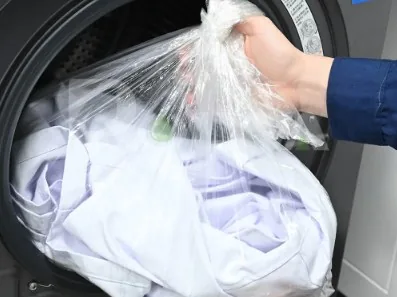
A hospital laundry bag has one non-negotiable requirement: it must hold a full load of soiled linen without failing, then dissolve completely in the wash so the bag never has to be opened by hand. That means the film is specified for wet load strength first and dissolve temperature second — the reverse of most water-soluble applications. This guide covers load rating against bag size, the infection-control reasoning behind the format, and the checks that stop a bag splitting in a laundry chute.
In a hospital laundry, the bag carries contaminated linen from the ward to the machine without anyone touching it. That is the entire point: the linen goes in at the bedside and never comes out of the bag until the bag itself has dissolved inside the wash.
Which means the bag has to fail in exactly the right place, and nowhere else. If it opens early — in the ward, in a service lift, or in a sorting room — contaminated linen is exposed and the whole control measure has been defeated. If it does not dissolve fully, you get residue on linen, film in the drum and a drainage filter full of polymer. Most problems in this category are one of those two, and both are specification issues rather than batch defects.
Two jobs that pull in opposite directions
Everything about the specification is a negotiation between these two requirements:
- Wet strength. Loaded at the bedside with damp linen, the bag has to cope with 5–10 kg of wet load, a walk through a hospital, a service lift, and a period of storage in a sorting area before it reaches the machine. PVA film loses strength as it absorbs moisture, so the time the bag spends damp matters as much as the load.
- Complete dissolution. Once it is in the drum, the bag has to dissolve entirely at the temperature and chemistry of your wash process — not nearly dissolve, entirely. Film fragments are visible against dark linen and are read by the customer as a defect.
A film thick enough to survive a long damp wait is a film that takes longer to dissolve. There is no formulation that removes the trade-off, so the practical answer is to establish the real numbers on your side: how long the bag is damp before it is washed, at what weight, and what your wash programme actually does.
Your wash cycle decides the grade
Hospitals launder on one of two routes, and the bag has to be matched to the one you actually run:
Thermal disinfection. The traditional hospital route: a hot wash with a defined temperature hold, in the region of 71 °C held for a short period, sometimes followed by a cool-down. The film here is a hot-water grade with a dissolution threshold below the disinfection temperature, so the bag is still intact through the cold fill and breaks down once the wash reaches the hold.
Low-temperature chemical disinfection. Increasingly common as energy costs and fabric care push temperatures down — a wash that stays in the 30–40 °C region and relies on a disinfectant chemistry rather than heat. This is where the most expensive mistakes happen, because a bag specified for a hot wash will survive this process almost unchanged. If your laundry runs low-temperature chemistry, say so at the enquiry stage; it changes the film.
We cover the grade families themselves in PVA film grades: cold, warm or hot water film, and the dissolving mechanism in what decides how fast PVA film dissolves. What matters for laundry is narrower: the bag must be insoluble below your sorting-room temperature and soluble above your disinfection temperature. That window is the specification.
Specify against the curve, not the set point
Wash programmes are usually quoted as a set point — "60 °C wash" — but a bag never meets a set point. It meets a curve: cold water enters the drum, the temperature climbs over several minutes, holds, and then falls. Two consequences follow.
First, the early part of the cycle is the coldest the bag will ever be, and it is also when it is under the most mechanical action. A film that is borderline at cold fill can start to soften and abrade before the wash has even reached working temperature.
Second, hold time matters as much as hold temperature. A bag that would dissolve in a full-length cotton programme may not fully dissolve in a short or economy cycle that spends far less time at temperature. If your laundry is moving towards shorter cycles for energy reasons, the bag specification has to move with it.
Load size belongs in the same conversation. An overloaded drum means less water movement per kilogram of linen, slower temperature rise, and less mechanical flushing of the dissolving film — which is how a bag that passed in a half-full test machine leaves residue in production.
Wet linen is the real stress test
The failure that reaches patients is not the one in the laboratory. It is a bag that softens during a long wait in a humid sorting area, or on a trolley that sits full over a warm weekend, and splits before it is loaded.
PVA is hygroscopic, so the variables to control are practical ones: how long a full bag waits before it is washed, how and where it is stored during that wait, and whether the film is being asked to cope with standing water in the base of the bag. Longer waits and warmer storage push you towards a slightly thicker or a higher-threshold grade; shorter waits and faster turnarounds let you specify for faster dissolving instead. If your turnaround varies between weekdays and weekends, specify for the worst case, not the average.
Where residue comes from
When residue is reported, it is worth working through the causes in order rather than changing the film first:
- Wrong grade for the process. The most common cause, and the one that most often goes undiagnosed because the film worked in a previous laundry with a different programme.
- Insufficient water movement. Overloading, or a bag that ends up trapped against the drum wall through the early part of the cycle.
- Short or cool cycles. Less time at temperature, and a cooler fill, both slow dissolution.
- Hard water. Higher mineral content slows PVA dissolution in the same way it does in a wash. A laundry in a hard-water area can need a different answer from one in a soft-water area for the same programme.
Residue is expensive in this setting because it is not only a cleaning problem. Linen that has to be re-washed consumes capacity, and film caught in drainage or filters becomes a maintenance line item that nobody planned for.
Print, colour coding and traceability
Hospital laundry bags usually carry information, and printing a dissolving bag is not the same as printing a normal pouch:
- Ink has to dissolve or disperse without transferring. Ink that lifts off the film and deposits on linen defeats the purpose, so print is specified together with the film rather than added afterwards.
- Colour coding. Many sites differentiate bag types or departments by colour, which requires the pigment to perform in exactly the same way as the rest of the print.
- Marking requirements. Where a site needs a department, date or handling instruction on the bag, that is part of the artwork brief from the start — not a label added later, which would defeat the closed-loop handling.
Validate on your own line, not in a datasheet
Film datasheets describe film. They do not describe your machine, your load or your turnaround. The only test that answers the question is your own process:
- Load sample bags with real linen at your real fill weight, including the wet-load case.
- Run them through the full production programme, including the cold fill phase.
- Check complete dissolution — bag gone, no fragments on linen, nothing in the door seal or filter.
- Repeat at the extremes you actually run: the shortest cycle, the heaviest load, and the coolest programme on the menu.
- Run a damp-hold trial separately, leaving filled bags for your worst-case wait and checking strength before washing.
Any sample approval that skips the damp-hold test is testing the easy half of the problem.
Are water-soluble bags specified by the NHS?
UK trust laundries and their contractors do buy water-soluble bags for infected and foul linen, but the requirement is written into each laundry’s own procedure rather than into one national bag standard: the bag must survive collection and transport intact, then dissolve completely in the wash the plant runs — no residue on linen, no plastic in the effluent. That is why the practical specification questions are always the same three: wash temperature, cycle length and mechanical action. It is also why we ask for your plant’s cycle before quoting a grade instead of sending a generic "hospital bag". Colour coding (often red for infected linen), print for traceability and the seam style sit on top of that. If you are tendering to a trust, send us the laundry’s written procedure — we translate it into a grade, thickness and bag format you can quote against, and supply samples for your own wash trial.
What to send us
- Laundry route: thermal disinfection or low-temperature chemical, with the programme temperature and hold time
- Shortest and coolest programme you intend to run the bags through
- Fill weight of linen per bag and typical damp-hold time before washing
- Bag dimensions and closure method (the bag has to work with how your staff actually close it)
- Print requirement, number of colours and any colour coding
- Quantity per order and annual volume
The same principle — specify against the real process, then prove it on samples — runs through our other applications, from agrochemical dosing packs to PVA bait bags. If your fill is a liquid rather than textiles, the closer comparison is detergent and single-dose film, where the film has to hold a wet fill for months and still dissolve completely.
Sources and standards
Primary references for the rules and test methods referred to in this guide:
 Sainsun PVA