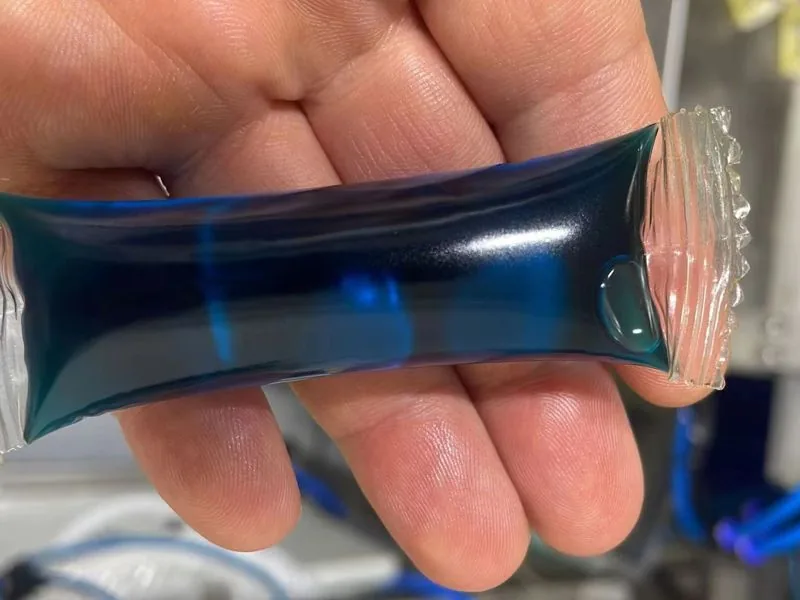
A liquid in a PVA pouch is a small pressure vessel: the fill presses outward on every part of the film, finds any weak seal, and keeps pressing through warehousing and shelf life — which is why liquid formats fail at the seal long before the film. The specification therefore starts from solvent compatibility and headspace rather than from film thickness, because a liquid that attacks the sealant will breach the pouch at any gauge. This guide covers the liquid-specific failure modes, the film and sealant combinations that tolerate an aggressive fill, and the pouch geometry that keeps pressure off the seal.
Detergent pods are the familiar example, but the format is spreading: single-dose shampoo and conditioner for hotels and travel, liquid fertiliser doses for small growers, sanitising concentrates, water treatment doses, cosmetic actives. In every case the buyer faces the same three decisions - which film, how much liquid, and how to fill it - and the same hidden fourth question: what happens to the film under a liquid load for the months between production and use.
A liquid load is a different mechanical problem
Film for a powder sachet only has to contain weight and survive handling. Film for a liquid pouch has to resist a hydrostatic head for the whole shelf life, and it does so at the weakest point in the structure, which is the seal.
Three consequences follow:
- Heavier gauge. Liquid pouches are normally run in a heavier film than powder sachets of the same footprint, because thinner film bulges more under load and the seal line carries more stress per millimetre. The right figure is found by testing the filled pouch, not by reading a data sheet - but as a working rule, the more the pouch bulges when full, the more film it needs.
- Seal quality becomes the critical control. A powder sachet with a marginal seal leaks powder slowly and looks untidy. A liquid pouch with a marginal seal fails at the fold where the seal meets the pouch body, often days after filling. Seal pressure, dwell time and temperature have to be set against the actual gauge and re-set whenever the gauge changes.
- Headspace matters. A pouch filled to the top has nowhere for the liquid to move. A pouch with a controlled headspace gives the film somewhere to flex. Overfilling is the most common cause of a leak that appears in transit rather than on the line.
Choosing the film for a liquid
Four properties decide whether a grade suits a liquid product, and all four are answerable before a sample is made:
- Compatibility with the liquid, not just the powder. Water-soluble film is sensitive to water activity and to solvents. A product that is mostly water, or contains a significant alcohol or glycol fraction, attacks the film from the inside. Grades differ in tolerance, and a lab compatibility test - sealed pouch, real product, held at elevated temperature for a few weeks - is the only honest answer.
- Dissolve temperature against the use temperature. A hotel shampoo pouch is opened in a warm shower; a fertiliser dose is dropped into a spray tank of cold water. Specify the temperature at which the film must be gone, then pick the grade that clears below it with margin.
- Cold-water strength before dissolving. The film has to stay intact while wet on the outside from condensation or a damp hand, and still dissolve at the intended moment. That balance is a grade property, not a thickness property.
- Clarity, if the product is seen. Clear film shows the liquid, which is a merchandising decision as much as a technical one - and it also means any haze, gel or colour drift inside the pouch is visible to the buyer.
Our single-dose liquid pouch page sets out the formats we run; the grade choice above narrows what the format can be.
Fill weight, geometry and what actually fits
Single-dose liquid pouches are usually specified by fill volume, and the volume then drives the pouch dimensions. Three practical limits:
- Fill weight against pouch area. Beyond a certain fill for a given film area, the pouch becomes a pillow and the seal line takes the load. Wider pouches with a shallower fill hold more reliably than narrow deep ones.
- Pouch shape against the machine. A three-side-seal pillow, a stand-up pouch and a shaped pod each need different tooling. Shape is a tooling decision first and a design decision second.
- Headspace and the fill tolerance. Filling machines hold a tolerance; if the maximum fill puts the pouch at its structural limit, half the production will be over it. Specify the target fill so that the machine's upper tolerance still leaves headspace.
Ask for the fill weight to be quoted with a tolerance and tested on the actual machine, not calculated from the pouch drawing.
Filling: vertical form-fill-seal or pre-made pouches
Two routes, with different economics:
- Vertical form-fill-seal (VFFS). Film runs off a roll, the pouch is formed, filled and sealed in one machine. Lowest film cost per pouch and the format is fully customized, but a liquid-capable VFFS with the right sealing system is a capital purchase, and changeover between formats takes time.
- Pre-made pouches. Pouches arrive formed; you fill and seal. Lower capital cost, faster to start, and practical for small volumes and for shaped formats - but the film cost per pouch is higher, and you inherit the pouch maker's seal quality.
For a brand testing a market, pre-made pouches with a modest fill volume are usually the cheaper route to a real product on a shelf. For a product that has found its volume, VFFS brings the unit cost down. The crossover depends on fill volume and annual quantity, and it is worth calculating rather than assuming.
If you would rather not own the machine at all, contract filling is the third route - we describe how that works, including what you send and what comes back, on our OEM filling service page.
Leak and compatibility tests before a batch ships
Four tests, in this order, will catch nearly every liquid pouch problem before it becomes a customer complaint:
- Compatibility hold. Fill real product into production pouches, seal, and hold at 40 °C for 2-4 weeks. Check for film softening, seal creep, colour change and weight loss. This is the test that finds an incompatible product before a container does.
- Squeeze test. Firm hand pressure on a filled pouch over a paper towel. A seal that weeps under hand pressure will weep in a carton.
- Drop and stack. Drop filled pouches from the height of a carton being handled, and stack cartons to the height you will actually ship. Leaks that appear only under stack load point to overfill or insufficient film gauge.
- Dissolve check in the use condition. Not in a beaker of distilled water at 25 °C, but in the water, at the temperature and agitation, that the end user will actually use. A dose that leaves a skin in a spray tank is a product failure even though the film passed its data sheet.
The same arrival discipline that protects dry film applies to pouches: film that takes up moisture in transit will not seal or dissolve to specification, and a pouch made from it inherits the problem invisibly.
What to send us
To quote a single-dose liquid pouch we need four things: the liquid's composition or at least its water and solvent content, the dose volume, the temperature at which it must dissolve, and the annual quantity. With those we can propose a grade, a gauge, a pouch format and either pre-made supply or a filling route - and we will tell you which of the four tests above we would run first for your product.
Sources and standards
Primary references for the test methods and regulatory framework referred to in this guide:
Machine cost ranges and the pre-made versus VFFS crossover are trade practice and vary by supplier and format; they are not standardised figures and should be quoted against your specific fill volume and quantity.
 Sainsun PVA