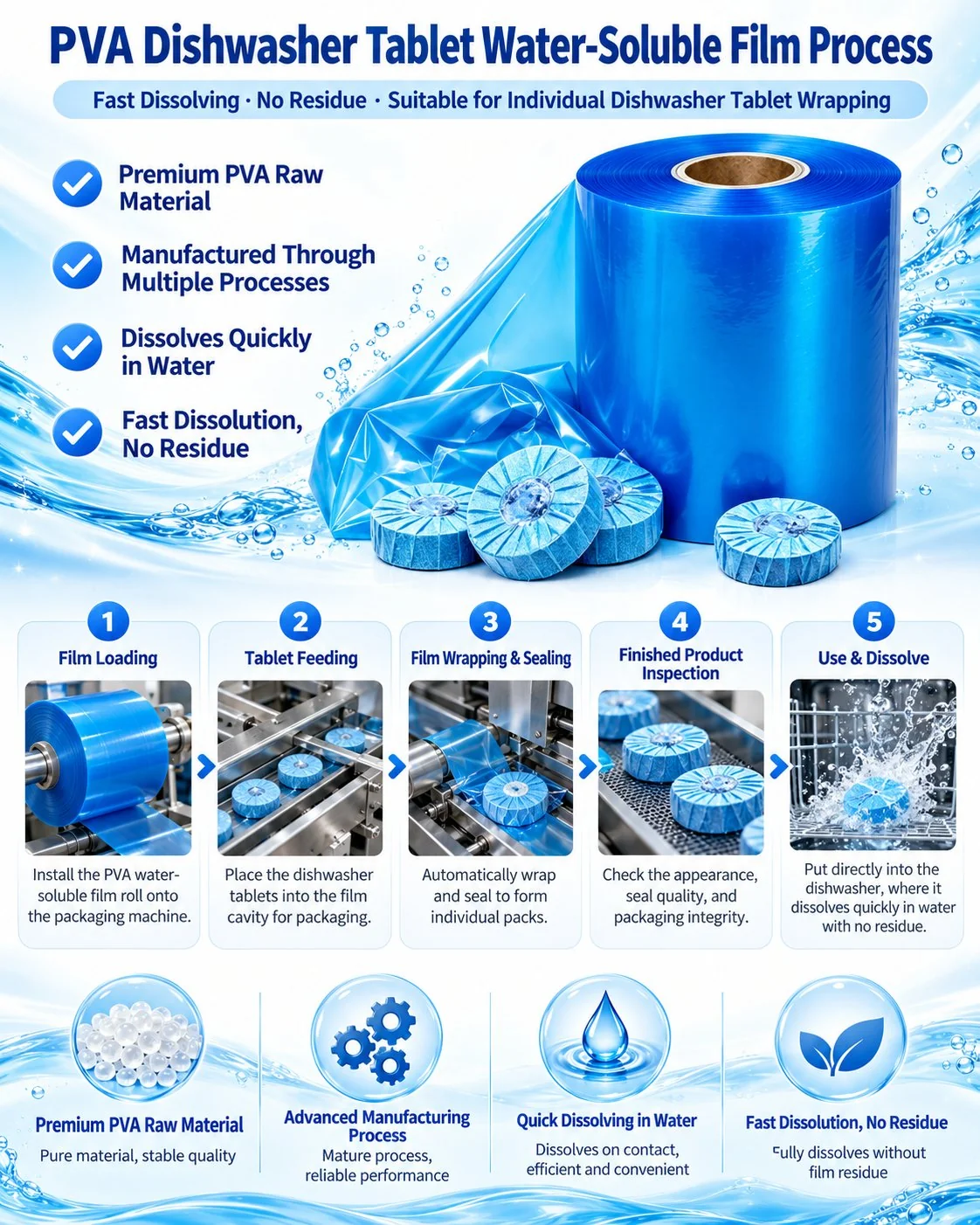
A dishwasher tablet film has to vanish on the first cold fill in hard water while the tablet is still dense and slow to wet — which is a harder starting condition than any laundry pod meets. The grading that matters is cold-water solubility at the machine's actual fill temperature, not the warm-water figure on the data sheet, and hard water is what turns a marginal film into a white residue on the glass. This guide covers the film properties a tablet needs, why a laundry pod film usually underperforms here, and the wash test that reproduces a customer's machine rather than a lab beaker.
Dishwasher tablets look like laundry pods with the colour removed, and buyers often assume the same film will do both. It rarely does. A laundry pod is formulated for a wash that fills a 40-60 litre drum with warm water and agitates for an hour or more. A dishwasher tablet is designed for a much smaller volume of water, at a lower starting temperature, with no agitation at all - the tablet sits in a dispenser drawer or a free-standing compartment until the door opens.
That difference changes three things at once: how fast the film must wet out, how much water it has to dissolve into, and what the film is in contact with before the wash starts. Each is a specification line, and each is where tablet film fails in the field.
Why tablet film is not pod film with a different name
Three differences decide the grade:
- The water budget. A dishwasher uses roughly 9-14 litres per cycle in a modern machine, and the first fill only part of that, whereas a laundry drum holds several times as much. Dissolving the same area of film in a quarter of the water takes longer and leaves a higher local concentration of polymer near the tablet. Film that dissolves cleanly in a drum can leave a skin in a dishwasher sump.
- The temperature path. Laundry programs are usually selected warm; many dishwasher cycles start with a cold pre-rinse and heat later. Film selected for a 40 °C wash start may not be the same grade as film that must clear a 25-30 °C pre-rinse. Ask what happens on the eco program, not on the intensive one.
- What touches the film first. A dishwasher tablet is often stored in the machine's dispenser for hours ahead of the cycle, next to rinse-aid residues, and the tablet itself releases a large mass of alkaline salts and enzymes into a small volume as it starts to wet.
The consequence for a buyer is simple: a film grade chosen for detergent pods is a starting point, not an answer. Specify the cycle your customer actually runs.
Thickness and pocket geometry
Tablet film is normally thinner than the film used for a liquid-filled pod, because there is no liquid head pressing on the film and no need to resist a fill needle. Published trade guidance for water-soluble packaging puts common tablet film gauges in the thin end of the range, with the exact micron figure set by the tablet press tooling and the pocket depth.
What matters more than the number is the match between three dimensions:
- Pocket depth against tablet thickness. A tablet that sits proud of the pocket stresses the film at the sealing plane and creates a thin spot that fails as a pinhole before the cycle starts. Over-deep pockets waste film and draw it thin at the corners.
- Draw ratio in the corners. Forming a pocket stretches the film. The corners of a rectangular tablet pocket see the highest stretch, and that is where thickness is lowest - and where a dissolve residue shows up first. A round or chamfered tablet profile buys forgiveness.
- Seal width and seal temperature. The seal zone is film welded to film, roughly double thickness, and it dissolves last. Narrow seals that run hot create a hard bead that outlasts the tablet; wide seals that run cool leak. Both show up as the same complaint: residue in the drawer.
Grade selection and pocket design have to be developed together. Our dishwasher tablet film page lists the gauges and widths we run; the film data sheet carries the tensile and dissolve figures that a pocket design should be checked against.
Salt load and rinse aid: the two contacts nobody specifies
The chemistry inside a dishwasher tablet is aggressive in a way laundry detergent is not. Tablets are built around high-dose alkaline salts, bleach activators and enzymes, and they are designed to release into a small water volume. Two contacts deserve a line in the specification:
- High ionic load at the wetting front. As the film wets, the first water that reaches the tablet dissolves a concentrated salt solution right against the film surface. Salt in solution changes how the polymer hydrates, and PVA grades differ in how they cope. A sample tested in clean water is not a test of this condition - it has to be tested with the actual tablet.
- Rinse aid. Many machines dose rinse aid into the same compartment area, and surfactant residue on the film surface lowers its wetting behaviour before the cycle begins. Where a brand sees intermittent residue complaints, a rinse-aid-free trial on the same batch is the quickest way to tell whether the film or the machine is responsible.
Both are reasons to test with the real tablet on a real machine, not with a film coupon in a beaker. A coupon tells you the grade dissolves; only the tablet tells you the pack dissolves.
The checks that catch a film that will not clear
Before a production run is committed, four checks separate a workable film from a recall:
- Dissolve time at the pre-rinse temperature. Not the rated temperature - the actual temperature at the moment the dispenser opens, on the eco program, in a cold kitchen. Record the time to full clearance and compare it with how long the machine runs before the first drain.
- Residue after a full cycle. Run the pack through a complete program and inspect the dispenser, the filter and the sump for film skins or a tacky deposit. Repeat on hard water, because the same film behaves differently at 350 ppm hardness than at 80.
- Storage before the cycle. Load a tablet into the dispenser and leave it there for 24-72 hours in a warm kitchen before running the cycle. Tablets live in the machine between uses; film that only works fresh from the box will generate complaints from the customers who use a tablet every other day.
- Pinhole and seal inspection after forming. A light table and a visual check on the formed pockets catches the thin corners and weak seals before they become customer complaints. The same discipline we describe for film arriving soft or blocked applies here: a check on the line is cheaper than a claim.
What to put in the specification
A dishwasher tablet film order that holds up reads roughly like this:
- Film grade named, with the rated dissolve temperature and the cold-water behaviour stated separately
- Gauge in microns, with a tolerance - not a nominal figure alone
- Pocket dimensions and tablet profile referenced to the tooling drawing
- Seal width and seal temperature range agreed against the forming machine
- Primary packaging: foil barrier bag with desiccant, and the storage limits the supplier will stand behind in writing
- An agreed acceptance test on arrival, with retained samples from each batch
Film is one input among several in a tablet pack - the tablet's own compaction and surface finish affect how it wets, and the pocket tooling decides how evenly the film is drawn. Send us the tablet dimensions, the machine's pre-rinse temperature and the water hardness in your main market, and we will quote a film and a pocket design that are checked against those three numbers rather than against a generic grade name.
Sources and standards
Primary references for the test methods and figures referred to in this guide:
Gauge and rinse-aid comments above reflect trade practice and our own production experience, not standardised limits; the exact figures are set by the tooling and the grade, and should be confirmed against the data sheet for the film actually ordered.
Quick answers
The questions buyers ask most about this topic.
Can we use the same film for dishwasher tablets and laundry pods?
Usually not without re-testing. A dishwasher cycle uses a fraction of the water, often starts colder and has no agitation, so the same film dissolves more slowly and can leave a residue. Start from the same grade family if you like, but specify and test against the dishwasher cycle you are selling into.
What thickness should a dishwasher tablet film be?
It is set by the pocket tooling and the tablet profile rather than by a single number - tablet film normally runs thinner than liquid-pod film because there is no liquid head to resist. The figure that matters is the thinnest point in the formed pocket corner, which should be checked on a light table rather than assumed from the nominal gauge.
Our tablets leave a film residue in the dispenser. Is the film at fault?
Not always. Test in this order: run the same batch with no rinse aid loaded, check the pre-rinse temperature on the eco program, check the water hardness, and try leaving a tablet in the dispenser for 48 hours before the cycle. If the residue follows the batch rather than the machine, it is the film or the seal.
Does hard water affect tablet film?
It can. Hard water changes how quickly the film hydrates and how completely the dissolved polymer clears, and the effect shows up more in a dishwasher's small water volume than in a laundry drum. Test at the hardness of your main market, not at the lab's tap.
What should we ask for on the film data sheet?
Gauge with a tolerance, rated dissolve temperature, cold-water behaviour, tensile strength and elongation to ASTM D882, and the storage limits the supplier will stand behind in writing. Ask separately what happens below the rated temperature, because that is the condition your customer's eco program creates.
 Sainsun PVA