PVA Film Certifications — What We Hold, and What We Won't Claim
Sainsun PVA · a division of Shenzhen Sainsun Packaging Co., Ltd.·Updated 2026-10-23
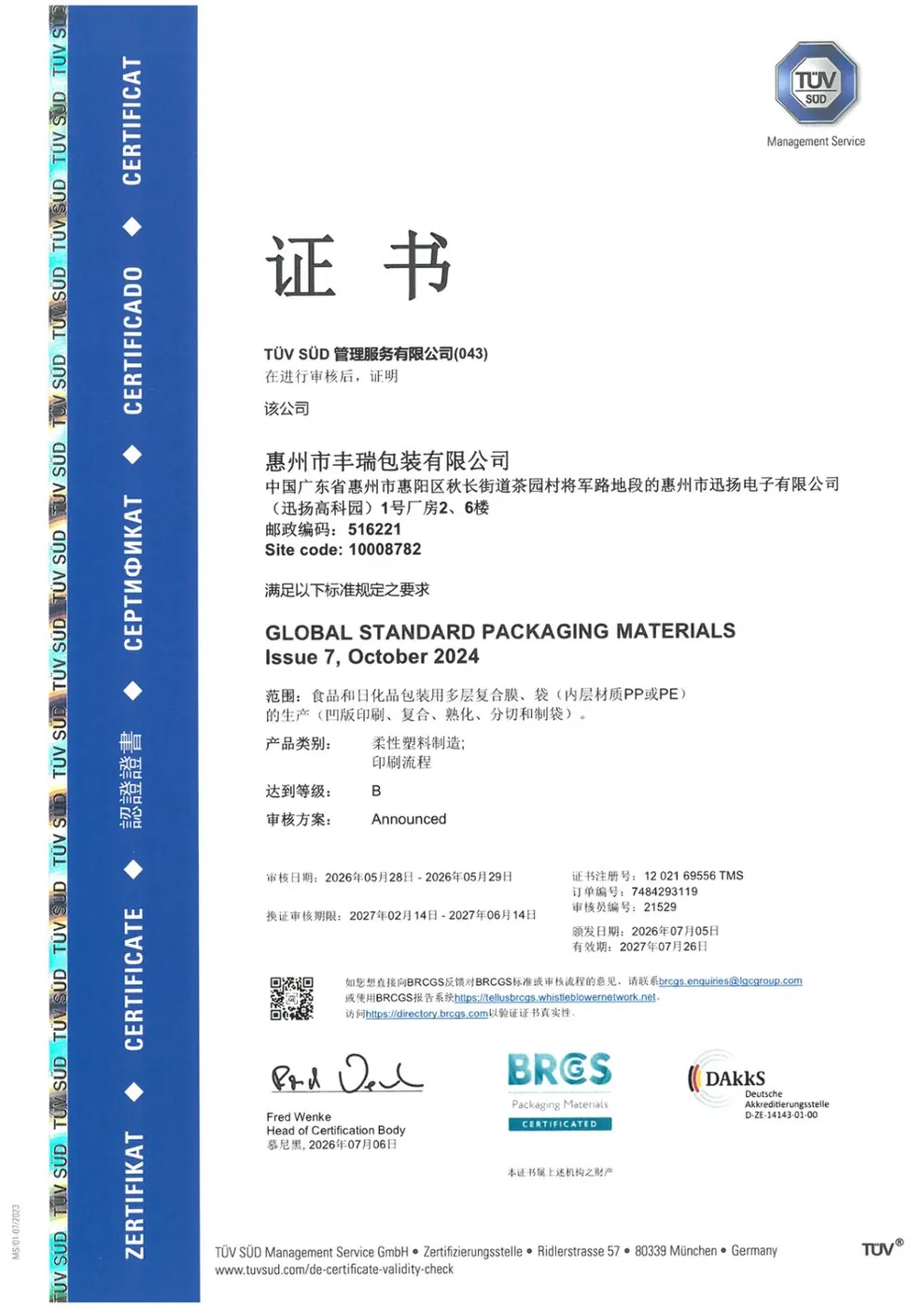
Short answer: the factory that makes your water-soluble film holds BRCGS Packaging Materials (Issue 7, Grade B, audited by TUV SUD), ISO 9001, a Sedex SMETA 4-pillar audit by Intertek and German LUCID registration. Film-specific food contact is a separate question — in the US the clause that governs PVA film is 21 CFR 177.1670, and it comes with a condition most buyers have never read. Both are set out below.
The documents we hold
One factory, one set of documents. Sainsun PVA is a division of Shenzhen Sainsun Packaging Co., Ltd., so the certificates below are issued to the legal entity that extrudes and converts your film — not to a trading company that buys it in. That legal entity is our plant, Huizhou Foraypack Co., Ltd. (BRCGS Site code 10008782, certificate registration 12 021 69556 TMS, TÜV SÜD, valid to 26 July 2027); sales, sampling and export run from Shenzhen Sainsun Packaging Co., Ltd. in Pingshan, Shenzhen.
Document
Issued by
What it covers
Status
BRCGS Packaging Materials, Issue 7, Grade B
TÜV SÜD
Hygiene, traceability and quality management in how packaging is made
Valid to Jul 2027
ISO 9001 quality management Cert. 46625Q111306R0S · issued 11 Dec 2025 · valid to 10 Dec 2028
Shenzhen Zhongxin
The management system the factory runs under
Certified
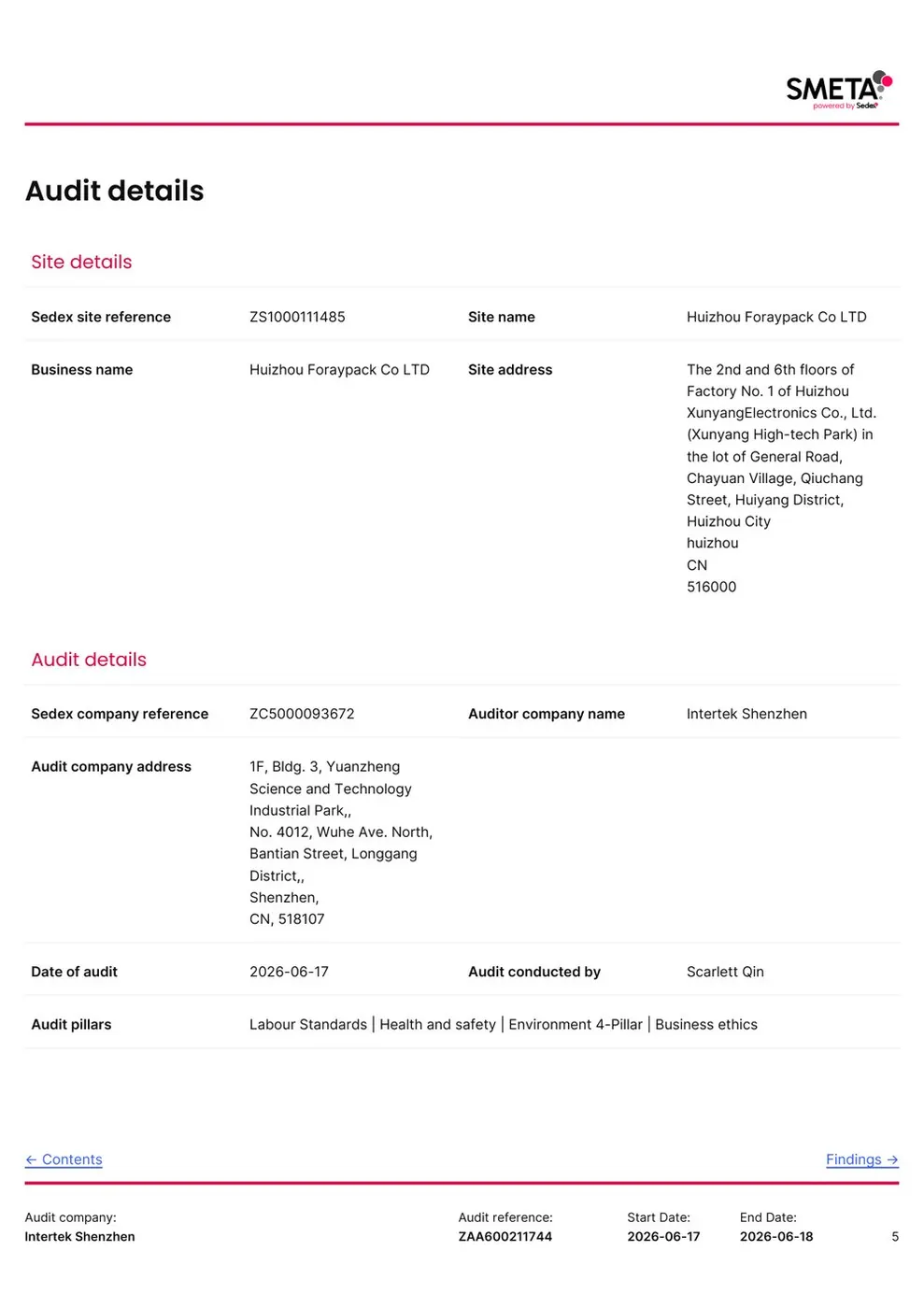
Sedex SMETA 4-pillar audit
Intertek
Labour · Health & safety · Environment · Business ethics
17–18 Jun 2026 · Intertek Shenzhen · Sedex site ref ZS1000111485
amfori BSCI full audit
SGS
Social compliance: management system, worker involvement, freedom of association, no discrimination, remuneration, working hours
6 Jun 2024 · overall rating B · monitoring ID 24-0254888
German LUCID packaging register
—
Registration under the German Packaging Act (VerpackG)
What 21 CFR 177.1670 actually permits for PVA film
This is the part most suppliers skip. In the United States, the food-contact clause that governs polyvinyl alcohol film is 21 CFR 177.1670 — not the olefin-polymer clause that covers polyethylene and polypropylene. It permits PVA film in contact with food of the types identified in §176.170(c), table 1, Types V, VIII and IX, under three conditions:
The film is produced from polyvinyl alcohol with a minimum viscosity of 4 centipoises, measured on a 4% aqueous solution at 20 °C.
For food Types V or IX, total extractives must not exceed 0.078 mg per cm² (0.5 mg per square inch) of food-contact surface, tested by ASTM F34.
The finished film shall not be used as a component of food containers intended for use in contact with water.
That last condition is not a loophole — it is the point of the material. A water-soluble film cannot be the barrier for a water-based product, and no certificate changes that. It is also why we ask what you are packing before we quote a grade.
We do not claim a blanket FDA approval covering every PVA application. Tell us the food type and the contact conditions and we confirm the grade and supply the matching report for your file.
EU food contact: confirmed per application
In the EU the framework is (EC) 1935/2004 — materials must not transfer anything to food in quantities that could harm health or change the food — with (EU) No 10/2011 setting the overall migration limit of 10 mg per dm² and the specific migration limits for listed substances. Whether a specific PVA grade is covered, and under which restrictions, depends on the polymer and on your contact conditions. We confirm which report covers the grade you are buying, in writing, before you commit.
What we do not claim
Compostability certification. We supply biodegradable and compostable film grades as well as water-soluble PVA — see which route fits your product. We do not hold an EN 13432 or OK compost certificate. If your market requires a certified mark, that certification belongs to the specific material and comes with the mill's certificate; dissolving in water is not the same thing as certified compostability.
Child resistance. Where a closure has to be child resistant, it is tested on the finished pack in the market where you sell. We build to spec and supply samples; the report belongs to the brand.
Migration for your product. Migration depends on what you pack, how long it sits and at what temperature. Our reports cover the material; your product in the pack is your test.
Organic, kosher or halal claims. Those certify a product and its whole chain. We do not hold them.
What we test
What is measured
Why it matters for water-soluble film
Dissolving temperature and residue
The number your customer actually feels — the pack has to vanish at the right temperature and leave nothing behind
Seal strength (ASTM F88)
Whether the seal survives handling and storage before it is meant to dissolve
Thickness and tensile
Whether the film carries the load without tearing on the line or in the pack
The film grade, thickness and dissolving specification actually used on your run
A compliance statement for the material supplied
The food-contact report that covers your grade, where applicable
Copies of the certificates on this page
Ask at quote stage, not after shipping. What we can issue is confirmed in writing with your quote, so there is no gap between what you expected and what arrives with the cartons.
The factory behind the documents
Shenzhen Sainsun Packaging operates a 10,103 m² facility with 10 production lines covering printing, lamination, slitting, bag-making and quality control. A team of 65 includes 3 R&D engineers and 4 dedicated QA/QC inspectors who sit inside the production flow rather than only at the end. Exporting since 2017.
How to ask for the reports
Send the market you sell in and what you are packing. We reply with the matching documents, usually the same day — and if we do not hold one, we say so instead of sending something close. On request we also send: our business licence, the SGS onsite verification report 485566894_T dated 7 February 2026, and bank details that match the company name on your proforma invoice — verify everything before any deposit.
The questions buyers ask most about PVA compliance.
Is your PVA film FDA approved for food contact?
The clause that governs PVA film in the US is 21 CFR 177.1670, which permits it for food Types V, VIII and IX with a viscosity floor of 4 centipoises and an extractives limit of 0.078 mg/cm² — and states it shall not be used for containers intended for contact with water. We do not claim a blanket approval; tell us the food type and we confirm the grade and supply the matching report.
What BRCGS grade do you hold?
Grade B under Issue 7, audited by TÜV SÜD, valid to July 2027. The scale runs AA down to D — B is a passing grade, not the top one, and we state it as issued.
Do you have a Sedex or SMETA audit?
Yes. A SMETA 4-pillar audit (labour, health and safety, environment, business ethics) was carried out by Intertek Shenzhen on 17–18 June 2026 (audit reference ZAA600211744, Sedex site reference ZS1000111485), and we are Sedex registered, so members can pull the audit directly. We also hold an amfori BSCI full monitoring audit by SGS from June 2024, overall rating B (monitoring ID 24-0254888).
Is your film certified compostable?
No. We supply biodegradable and compostable film grades as well as water-soluble PVA, but we do not hold an EN 13432 or OK compost certificate. If your market needs a certified mark, that certification comes with the specific material from the mill.
Can I get the certificate PDFs before I order?
Yes. Send the market you sell in and what you are packing, and we send the matching documents, usually the same day. If we do not hold one, we say so rather than sending something close.
Tell us what you pack
Send your product, the pack size you need and your target quantity. Reply within 24 hours with a film recommendation, a sample plan and a quote.
 Sainsun PVA